As your business grows, so does the list of things you're legally required to stay on top of: corporate secretarial filings, accounting, tax submissions to IRAS, CPF payroll obligations, GST registration, annual returns to ACRA. For most SME founders, the first instinct is to handle each piece separately — one firm for accounting, another for Corporate Secretary, a freelance bookkeeper for payroll.
It works. Until it doesn't.
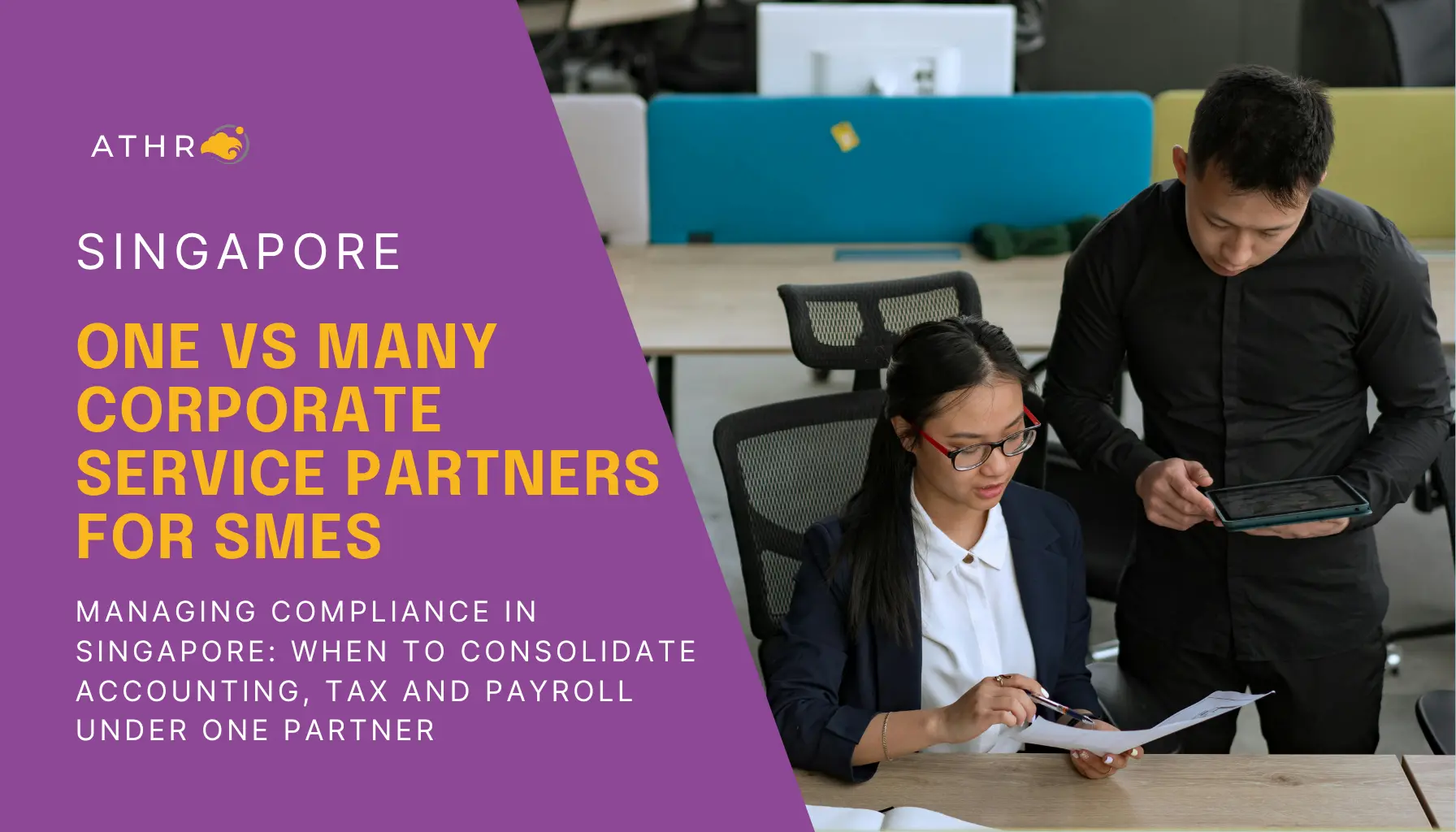
At some point, the fragmentation creates friction — missed deadlines, conflicting advice, duplicated effort, and hours spent coordinating instead of running the business. That's usually when founders start asking: should I consolidate everything under one corporate service partner?
This article breaks down both approaches — single-partner and multi-vendor — and helps you decide what actually makes sense for your Singapore SME.
What Is a Single-Partner Strategy for Corporate Services?
In the context of Singapore corporate services, a single-partner strategy means working with one firm to handle your full compliance and back-office needs — company secretarial, accounting, tax, payroll, GST, and any ad hoc advisory you need. One team. One point of contact. One fee structure.
This model is most common among SMEs that want operational clarity and predictable costs.
What Is a Multi-Vendor Strategy?
A multi-vendor approach means engaging different providers for different functions: perhaps a boutique accounting firm, a separate corporate secretarial agent, and an independent payroll processor. Each is chosen for their specific expertise or price point.
This model appeals to founders who want best-in-class services in each category, or who've built long-standing individual relationships with specific providers.
The Case for Working with One Corporate Services Partner
1. Less Admin, More Focus
Managing one provider means one contract, one invoice, one onboarding process, and one relationship to maintain. For lean SME teams — or solo founders — that reduction in administrative load is real and significant. You're not chasing three firms for updates before a board meeting.
2. Better Coordination Across Functions
Accounting, tax, payroll, and corporate secretarial are not independent functions. They share data, affect each other's outputs, and need to be aligned. When separate vendors handle each, important details can fall through the cracks — a payroll run that doesn't match the P&L, or a Corporate Secretary filing that doesn't reflect the latest share allotment. One team with full visibility eliminates most of these coordination risks.
3. Stronger Service Relationship
When you're a meaningful client to one firm rather than a peripheral account across several, you tend to get better attention. Your service provider learns your business, anticipates issues, and becomes genuinely invested in your compliance health — not just in completing the next transaction.
4. Clearer Accountability
If something goes wrong — a missed deadline, an incorrect submission — there's no ambiguity about who is responsible. One partner, one accountability. Multi-vendor arrangements can devolve into each firm explaining why the gap was someone else's fault.
5. Potential Cost Efficiency
Bundling services with a single provider often unlock better pricing than engaging each vendor separately at retail rates. It also eliminates duplicated setup costs, repeated data entry, and the management overhead that eats into whatever you saved by shopping around.
The Case for Using Multiple Vendors
1. Specialist Depth
Some businesses genuinely need deep expertise in one area — a complex transfer of pricing arrangement, industry-specific tax structuring, or a niche payroll requirement. In these cases, a specialist firm may outperform a generalist across-the-board provider.
2. Risk Distribution
No single provider is infallible. Some founders prefer not to have all their compliance obligations under one roof, particularly if they've had a bad experience with a provider transition in the past.
3. Competitive Benchmarking
Working with multiple vendors can give you a clearer sense of market pricing and service quality, making it easier to identify when a provider is underperforming.
The Real Trade-Off: Simplicity vs. Fragmentation
Both models have legitimate use cases. But for most Singapore SMEs — especially those with fewer than 50 employees — the multi-vendor approach introduces coordination complexity that is difficult to manage without a dedicated finance or operations team.
Consider what you're actually buying when you engage a single corporate services partner: not just execution, but coordination. Your annual return, your payroll run, your accounts filing, your GST return — all handled by people who already understand your business structure and share information internally. That coordination has real value.
The multi-vendor model transfers the coordination burden to you, the founder. And that's a cost that rarely shows up in any individual vendor's invoice.
How to Decide: A Practical Framework for Singapore SMEs
Ask yourself the following:
What is your team capacity? If you don't have a dedicated finance manager or operations lead, multi-vendor management will likely become your problem. A single partner reduces that burden significantly.
How complex are your compliance needs? For straightforward accounting, payroll, and Corporate Secretary— a competent full-service partner handles it well. If you have highly technical tax matters, you may need specialist input, but that can often be handled as a supplementary engagement alongside a core partner.
What has failed before? If you've had coordination failures — missed filings, inconsistent records, last-minute scrambles — the issue is usually fragmentation. Adding more vendors rarely solves it.
Are you in growth mode? Scaling companies benefit most from a single corporate services partner who can grow with them: adding payroll for new hires, upgrading accounting complexity, handling a subsidiary incorporation — without onboarding three separate vendors each time.
What to Look for in a Single Corporate Services Partner
If you decide to consolidate, the quality of the partner matters enormously. Look for:
- Breadth of services — Corporate Secretary, accounting, tax, payroll, GST, and advisory under one roof
- Singapore-specific expertise — deep knowledge of ACRA, IRAS, MOM, and CPF requirements
- Responsive communication — a dedicated point of contact, not a helpdesk queue
- Proven track record — years of experience with Singapore SMEs across different industries
- Transparent pricing — clear scope, no surprise add-ons
The Bottom Line
For most Singapore SMEs, the single-partner model offers a clear operational advantage: less admin, better coordination, clearer accountability, and a service relationship that deepens over time. The multi-vendor model can make sense when your needs are genuinely complex or highly specialized — but for the majority of businesses, it simply transfers management burden onto the founder without a proportionate benefit.
At ATHR Corporate Services — backed by PWCO's 40+ years of Singapore corporate expertise — we work with SMEs that have made the decision to consolidate. Our clients range from newly incorporated companies to established businesses that have outgrown their patchwork of vendors.
We handle company incorporation, corporate secretary services, bookkeeping, payroll management and more — coordinated by a single dedicated team who knows your business.
👉 If you're ready to simplify your compliance setup, get in touch with us for a no-obligation consultation.