Paying your employees on time does not automatically mean your payroll records are correct. Your payroll report, bank statement and accounting records can show different totals, even when every salary payment has gone through.
Payroll accounting in Singapore connects these records. It helps you check what employees earned, what the company paid and what remains outstanding.
This guide explains how to reconcile payroll using everyday language and a worked example. It covers the main Singapore requirements applicable as of October 2026, without requiring you to become a payroll specialist.
Key takeaways
Net salary payments usually differ from the company's total payroll cost.
Employee CPF comes out of gross wages; employer CPF is an additional employer cost.
Reconciliation checks individual payments, contributions and ledger balances, with evidence for any differences.
An outstanding balance can be valid, but it needs an explanation and follow-up.
What Is Payroll Accounting in Singapore?
Payroll accounting records the cost of employing people, deductions from their earnings, payments made and amounts still owed. In Singapore, it connects salary calculations with contributions such as CPF, bank transactions and the company's financial records.
Payroll processing and payroll accounting: how they connect
Payroll processing calculates what each employee should receive. Payroll accounting records the resulting costs and obligations in the company's accounts.
For example, an employee may earn September salary but receive payment in October. Under accrual accounting, September's salary cost belongs in September, with the unpaid amount recorded as a liability.
Start by understanding what each record tells you:
Record
What it tells you
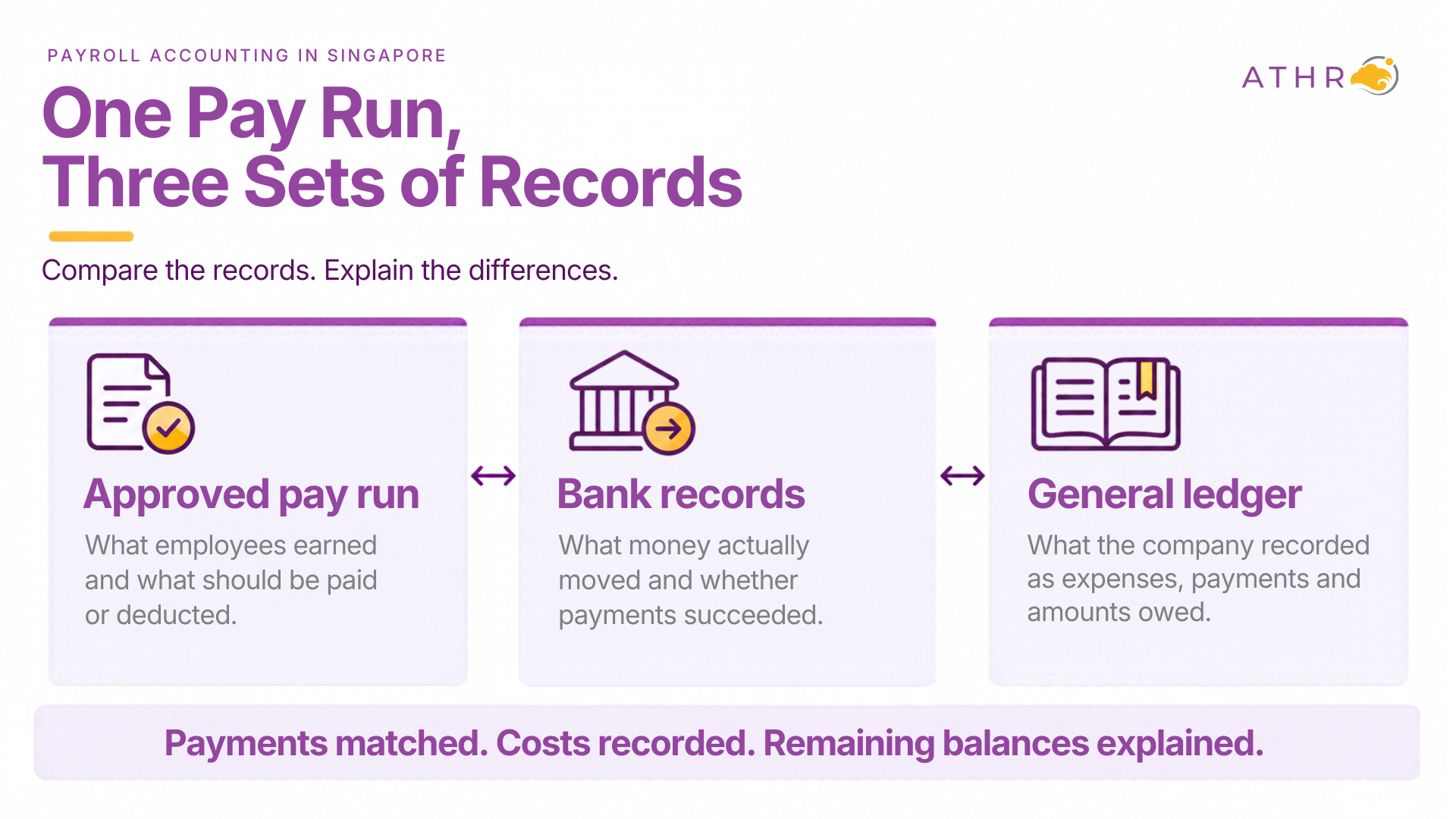
Approved pay run
What employees earned and what should be paid or deducted
Bank records
What money actually moved and whether payments succeeded
General ledger
What the company recorded as expenses, payments and amounts owed
The general ledger is your company's main accounting record.
One Pay Run, Three Sets of Records
Understand the Amounts Before You Compare Them
Payroll figures represent different things. Separate earnings, deductions, employer costs and reimbursements before comparing totals.
Gross pay and net pay
Gross pay is earnings before employee deductions. It can include basic salary, allowances, overtime, commissions and bonuses.
Net pay is the salary remaining after applicable deductions. Use the following starting point:
Net salary = gross pay − employee deductions
If reimbursement is paid in the same transfer, show it separately when reconciling the bank amount. Some payroll reports include claims within a field labelled “net pay”, so check the report's definition first.
Employee deductions and employer contributions
The Central Provident Fund (CPF) is Singapore's social security savings scheme. Employee CPF is deducted from gross wages, while employer CPF adds to the employer's cost.
Other components need separate treatment:
Component
How to understand it
Employee CPF
Part of gross wages withheld for payment to CPF Board
Employer CPF
An additional employer contribution
Skills Development Levy (SDL)
An employer levy supporting workforce development
Self-Help Group (SHG) deductions
Applicable employee contributions collected through payroll
Payroll liabilities
Payroll-related amounts still owed to employees or other parties
Check each employee's eligibility and applicable scheme rules. The CPF Board's SHG guidance explains the different funds and contribution arrangements.
A reimbursement repays an employee for an expense incurred on the company's behalf. For example, an employee buys office stationery and submits the receipt for approval.
Record the stationery under the appropriate expense account. If that expense was already recorded when the claim was approved, paying the employee should clear the amount owed.
Prepare Your Payroll Reconciliation Documents
Use the final approved payroll version and collect the records needed to trace it. Mixing a draft report with the final payment file can create differences that are difficult to explain.
Prepare:
The approved payroll report and payslips.
Approved salary changes, bonuses, overtime, leave and expense claims.
Bank statements and detailed payment results.
CPF submissions, SDL and SHG details, and payment confirmations.
Payroll journal entries and related ledger balances.
The previous month's reconciliation and unresolved items.
A payroll journal is the accounting entry that records a pay run. Your software may create it automatically, or your accountant may enter it.
Use employee identifiers, pay periods and payment references consistently. Restrict payroll records to authorised people. For new hires, confirm the information required under your Singapore hiring obligations.
How to Reconcile Payroll in Singapore, Step by Step
Reconcile payroll in stages: validate the approved figures, confirm payments, then check the accounting entries and remaining balances. Give each unresolved item an owner so the review produces action.
Step 1: Check the approved pay run
Before releasing payments, compare the payroll report with approved employee changes. HR or the payroll preparer should explain changes in headcount, salaries, deductions and variable pay.
Compare this month's figures with last month's, but investigate the reason for each material movement. A higher total may be correct because someone joined or earned a bonus.
Confirm that leavers have been handled correctly and that unpaid leave has not been deducted twice. For practical preparation, our guide to avoiding payroll processing delays explains why a clear cut-off matters.
Step 2: Match employee payments to net pay
After the bank processes payments, compare each employee's approved amount with the payment result. Check the recipient, amount, payment date and any reimbursement included.
A bank upload confirmation only proves that a file was submitted. Review successful, rejected, pending and returned transactions before marking payroll as paid.
If the bank statement shows one batch debit, use the detailed payment report to identify the employees within it. Trace retries separately to avoid paying someone twice.
Practitioner's Note:
A matching batch total can hide individual errors. Paying one employee S$100 too much and another S$100 too little leaves the total unchanged.
Step 3: Reconcile CPF and other payroll payments
Compare the payroll contribution report with the submitted contribution details. Then match the actual payment to the submission and the relevant ledger accounts.
Check employee CPF and employer CPF separately before combining them. Identify SDL, SHG deductions and any prior-period adjustments included in the payment.
For example, a bank debit containing CPF and SDL will exceed the CPF-only total. Use the submission breakdown to explain the difference and allocate the payment correctly.
Review individual employee details as well as totals. A correct overall payment does not establish that contributions were allocated correctly.
Step 4: Match the pay run to the ledger
Your accountant or bookkeeper should compare the approved payroll report with the journal. Confirm that gross salaries, employer contributions and deductions appear in the correct accounts and period. Keep supporting reports with the entries.
Next, trace the bank transactions to the amounts owed. Where payroll costs have already been recorded, the later payment should clear the relevant liability.
Practitioner's Note:
A bank rule that automatically posts salary transfers to “Wages expense” can duplicate a payroll journal. Check the existing entry before accepting an automatic categorisation.Also check whether claims, bonuses or additional pay runs were already posted separately.
Step 5: Explain and follow up outstanding balances
For each payroll liability account, use this reconciliation:
List what makes up the closing balance. Identify the employee or agency, pay period, reason it remains outstanding and expected resolution.
An unpaid contribution and a payment posted to the wrong account can produce similar balances, but require different actions. Inspect the evidence before deciding which applies.
Employee A also has an approved S$200 stationery reimbursement. For simplicity, SHG and other deductions are excluded from this teaching example; an actual pay run must assess them.
Item
Employee A
Employee B
Total
Gross salary
S$4,000
S$4,000
S$8,000
Employee CPF
S$800
S$800
S$1,600
Net salary
S$3,200
S$3,200
S$6,400
Reimbursement
S$200
S$0
S$200
Payment to employee
S$3,400
S$3,200
S$6,600
Employer CPF
S$680
S$680
S$1,360
SDL
S$10
S$10
S$20
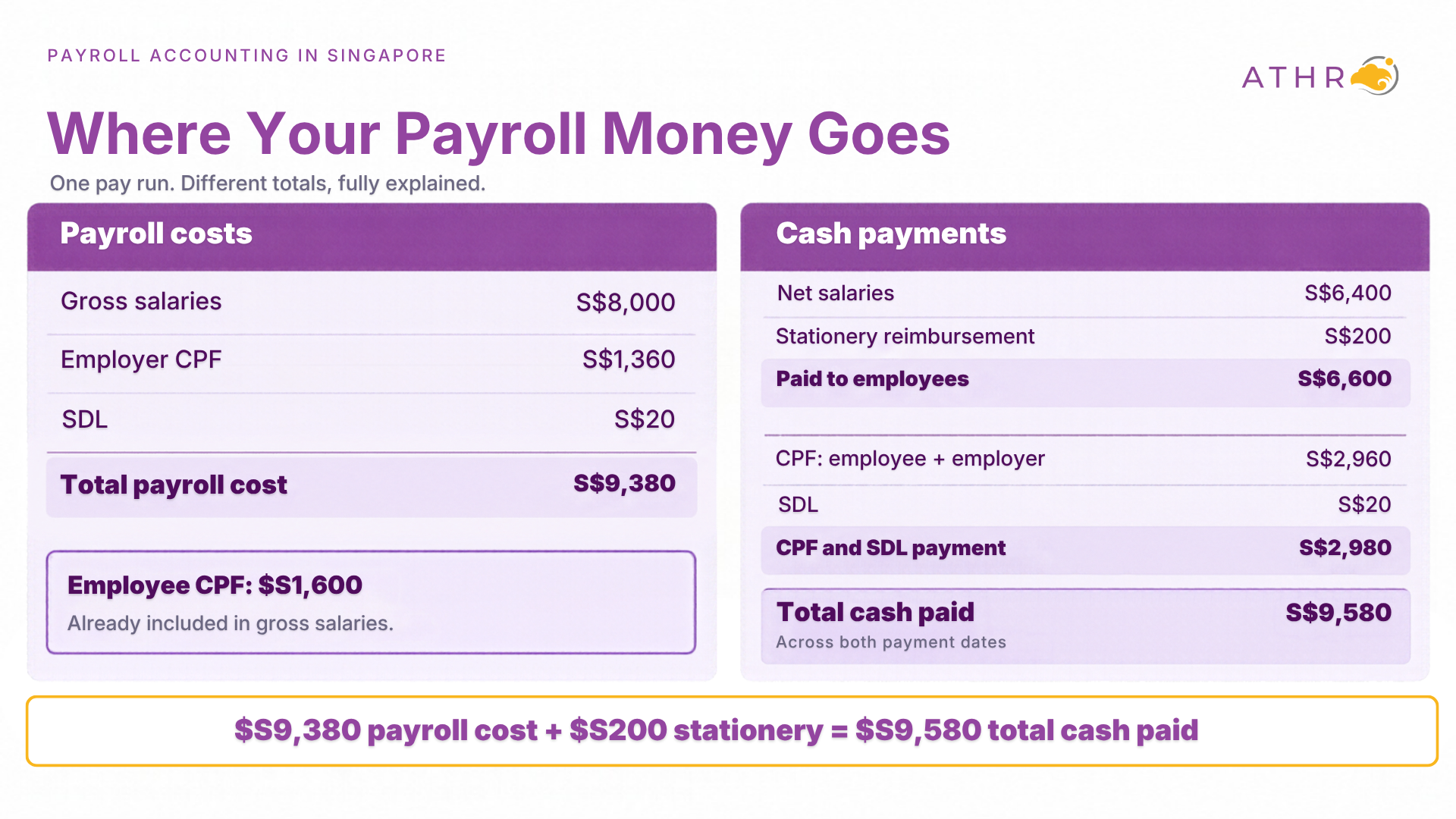
The company's payroll cost is S$9,380: gross salaries of S$8,000, employer CPF of S$1,360 and SDL of S$20.
The S$200 stationery expense is separate. Employee CPF is already included in gross salaries.
Record payroll and the approved claim
Assume there are no opening balances and the stationery claim has not previously been recorded. Ignore GST in this simplified example.
The accounting entries are:
Account
Debit
Credit
Salary expense
S$8,000
—
Employer CPF expense
S$1,360
—
SDL expense
S$20
—
Net salaries payable
—
S$6,400
CPF payable: both shares
—
S$2,960
SDL payable
—
S$20
Stationery expense
S$200
—
Employee reimbursement payable
—
S$200
Total
S$9,580
S$9,580
Here, debits record expenses and credits record amounts owed.
Match the employee payments
Suppose both employee payments succeed on 30 September. Record a debit of S$6,400 to salaries payable and S$200 to reimbursement payable, with a S$6,600 credit to the bank.
This clears the employee balances. As of 30 September, CPF payable of S$2,960 and SDL payable of S$20 remain outstanding.
When the company subsequently pays S$2,980 for CPF and SDL, debit those payable accounts and credit bank. The payment clears existing liabilities without creating another payroll expense.
Across both payment dates, S$6,600 + S$2,980 = S$9,580. That agrees with payroll costs of S$9,380 plus stationery of S$200, given this example's assumptions.
Why Do Payroll, Bank and Ledger Figures Not Match?
Differences can arise because the records cover different components, payment dates or payroll versions. Others come from missing payments, duplicate entries or incorrect calculations. Start by identifying exactly what each figure includes, then trace the difference to supporting documents before deciding whether an accounting correction is needed.
Where Your Payroll Money Goes
What you notice
What to check
Action
Employee payments exceed net salary
Claims, advances or additional payments
Separate and verify each component
Employee payments are lower than expected
Failed transfers, partial payments or authorised amounts held
Establish what remains owed and why
Salary expense appears twice
Payroll journal plus a bank entry to expense
Correct the duplicate accounting treatment
Contribution payment differs from CPF total
SDL, SHG or prior-period corrections
Match against submission details
Old balances remain after payment
Wrong account, missing transaction or incorrect opening balance
Trace the original obligation and settlement
A small difference repeats monthly
Calculation or rounding settings
Apply the correct rule and document the correction
SDL provides a useful rounding example. CPF Board instructs employers to calculate SDL per employee, add the amounts and round the total down to the nearest dollar.
Keep a short difference log showing the amount, cause, evidence, correction and reviewer. If the cause is unknown, record it as unresolved.
Singapore Payroll Rules That Affect Your Reconciliation
Your reconciliation should check compliance as well as arithmetic. A payment can match the ledger and still be late or based on incorrect employee information.
Salary payments and payslips
For employees covered by the Employment Act, salary must generally be paid at least monthly and within seven days after the salary period ends. Overtime is generally payable within 14 days; final salary has separate rules.
MOM requires itemised payslips with payment, or within three working days if they cannot be issued together. For termination or dismissal, provide the payslip with outstanding salary.
CPF, SDL and deductions
The CPF Ordinary Wage ceiling is S$8,000 per month from 1 January 2026. Check age, citizenship or Permanent Resident status, wage level and wage classification before calculating contributions.
CPF contributions are due on the last day of the calendar month. Enforcement follows if unpaid by the 14th of the next month, subject to the next-working-day rule for weekends and public holidays.
SDL generally covers employees working in Singapore, including foreign employees. Its rate is 0.25% of monthly total wages, with a S$2 minimum and S$11.25 maximum per employee.
Check SHG deductions separately against the relevant scheme. Where foreign worker levies apply, also reconcile the levy bill, payment and employer expense.
Employers under the Auto-Inclusion Scheme (AIS) submit electronically. Employers outside AIS provide the required forms to employees. Reconcile annual reportable income separately: benefits and reporting rules mean it may differ from salary bank payments.
When IR21 tax clearance applies, employers generally notify IRAS at least one month in advance and withhold monies upon learning of the relevant departure or cessation.
Check the exceptions and release instructions. Our Work Permit cancellation guide explains how departure procedures connect with final payroll.
Your Month-End Payroll Reconciliation Checklist
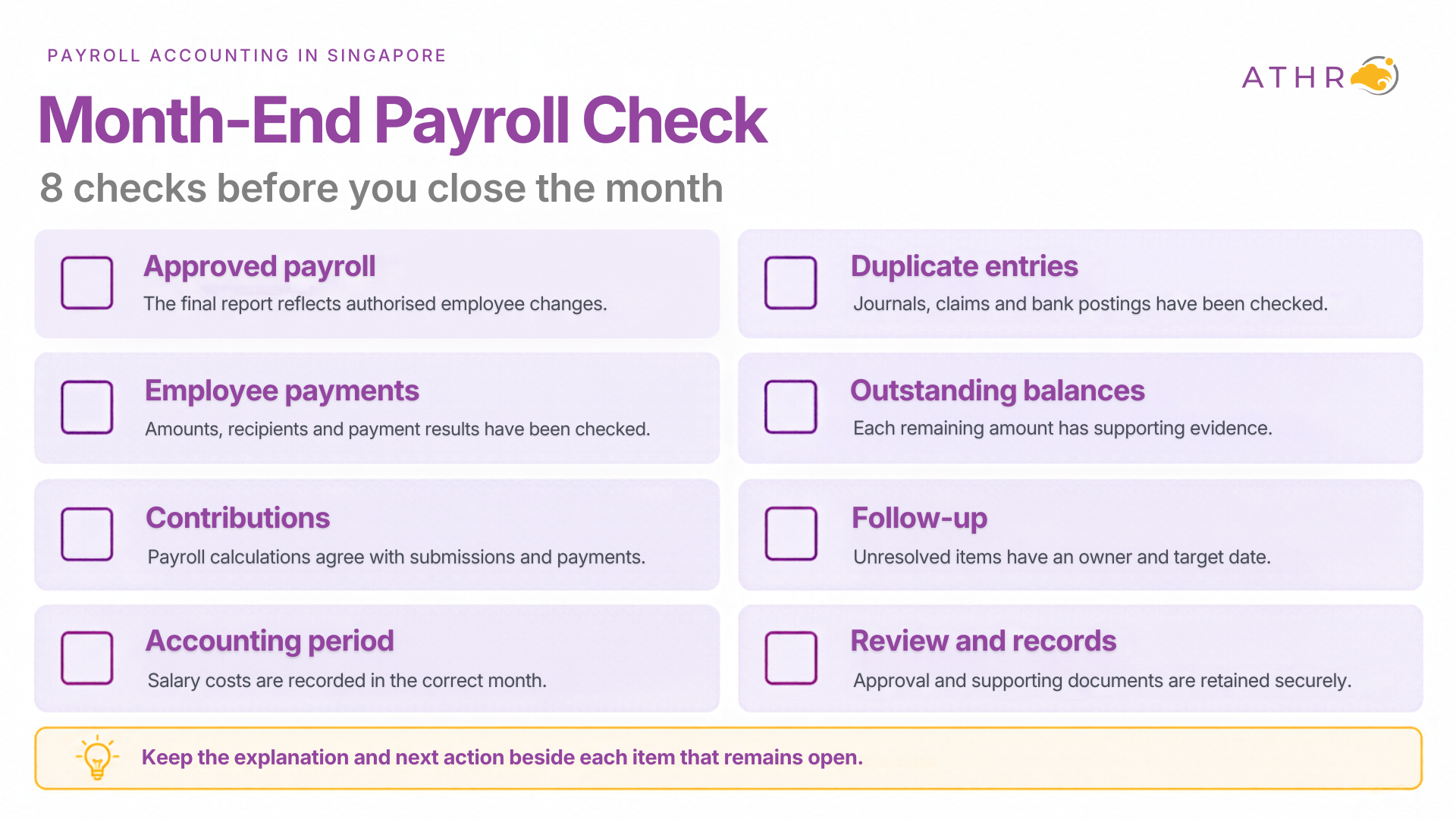
Complete the review with a documented checklist. Keep the explanation and next action beside each item that remains open.
Approved payroll: The final report reflects authorised employee changes.
Employee payments: Amounts, recipients and payment results have been checked.
Contributions: Payroll calculations agree with submissions and payments.
Accounting period: Salary costs are recorded in the correct month.
Duplicate entries: Journals, claims and bank postings have been checked.
Outstanding balances: Each remaining amount has supporting evidence.
Follow-up: Unresolved items have an owner and target date.
Review and records: Approval and supporting documents are retained securely.
Reconciliation is complete when the records agree and remaining differences are understood, documented and followed up.
Month-End Payroll Check
Frequently Asked Questions About Payroll Accounting in Singapore
Should salaries be recorded at gross pay or net pay?
Record salary expense at gross pay, with employee deductions allocated to the relevant accounts. Net pay is the salary amount owed to the employee after deductions. Employer CPF and SDL are additional employer costs. Recording only the employee's bank payment as salary expense can understate the cost.
Is employee CPF an additional expense for the employer?
No. Employee CPF is already included within gross salary. The employer withholds that portion and pays it to the CPF Board together with the employer's contribution. Employer CPF is the additional cost. Keeping both shares separate in your reconciliation helps prevent double-counting and supports checking the submission.
How do I reconcile one bank payment covering several employees?
Use the bank's detailed payment report to break the batch into individual recipients. Match each payment to the approved payroll and confirm the successful payments agree with the bank debit. Check rejected payments, refunds and bank charges separately; the batch reference alone does not establish that everyone was paid correctly.
How do I record the salary earned this month but paid next month?
Under accrual accounting, record the salary cost in the month the employee provided the service. Keep the unpaid amount in salaries payable. When payment is made, reduce that liability. The accounting treatment does not extend the legal payment deadline, which you must check separately.
Should payroll liabilities always be zero at month-end?
No. A balance can represent an amount incurred but not yet settled, or monies legitimately held for tax clearance. Explain each balance by employee or agency and pay period, and verify its status against the applicable payment requirements.
Does payroll software remove the need for reconciliation?
No. Software helps calculate payroll and transfer entries, but it depends on correct employee information, settings and approvals. It cannot establish that a bank payment succeeded merely because a payment file was generated. Review integrations, manual adjustments and payment results as part of the monthly process.
How long should a Singapore company keep payroll records?
Different requirements apply. MOM requires the latest two years of payslip records for current employees. For former employees, retain their last two years of records for one year after departure.
If payroll figures are difficult to explain, begin with your latest approved pay run, bank payment records and payroll ledger balances. These help identify whether the issue concerns calculations, payment processing or accounting entries.
ATHR's payroll support includes monthly calculations and summaries, CPF filing, SHG reporting and annual AIS preparation and submission, within the agreed service scope. Our bookkeeping services can support the accounting records alongside payroll.
For example, coordinated payroll and bookkeeping support can help distinguish an unpaid contribution from a payment recorded in the wrong account. Agreeing who handles each check also makes follow-up clearer.
The ATHR Content Team is a group of professional writers from Singapore and the Philippines, committed to delivering informative, practical, and engaging content for business owners across Southeast Asia.
Free yourself from routine business tasks and let ATHR take the weight of financial administration off your shoulders. Smart solutions, seamless service, zero hassle.