Thinking about making Singapore your long-term home? A Singapore PR application is more than an administrative form. It is a serious milestone that can affect your work stability, family planning, children’s education, and long-term future in Singapore.
Permanent Resident status allows a foreigner to reside in Singapore on a permanent basis. PRs aged 15 and above are issued a Singapore blue Identity Card, and PRs must hold a valid Re-Entry Permit if they wish to travel out of Singapore and return as PRs.
In 2026, the application environment remains selective. Singapore granted 35,264 individuals' permanent residency in 2024, and the average number of PRs granted per year over the last five years was around 33,000. However, approval is not automatic. Singapore maintains a measured immigration approach and assesses applicants based on contribution, integration, and long-term commitment.
This guide explains who can apply, what ICA looks at, what documents to prepare, how the process works, and what foreign entrepreneurs should understand before using a business as part of their Singapore PR pathway.
What Is Singapore Permanent Residency?
Singapore Permanent Residency gives eligible foreigners the right to live, work, and study in Singapore with greater long-term stability than a work pass or student pass.
For many applicants, PR is also a step towards deeper roots in Singapore. It may support long-term career development, family relocation, home planning, and future citizenship considerations. At the same time, PR carries responsibilities, including Re-Entry Permit requirements and National Service obligations for certain male applicants.
ICA makes clear that all male Singapore citizens and PRs, unless exempted, are required to serve National Service under the Enlistment Act. Male applicants and families including male children should review this carefully before proceeding.
Who Is Eligible to Apply for Singapore PR in 2026?
ICA lists several categories of foreigners who may be eligible to apply for Singapore Permanent Residence. The main categories include spouses of Singapore citizens or PRs, unmarried children below 21, aged parents of Singapore citizens, Employment Pass or S Pass holders, eligible students studying in Singapore, and foreign investors applying through the Global Investor Programme.
Employment Pass or S Pass Holders
This is one of the most common routes for working professionals in Singapore. EP and S Pass holders submit their PR application through the ICA e-Service using Singpass.
For professionals, technical personnel, and skilled workers, this route is commonly referred to as the PTS pathway. It is especially relevant for foreign employees, senior executives, specialists, and business owners who are legally employed by their Singapore company through a valid work pass.
Spouse or Child of a Singapore Citizen or PR
A spouse of a Singapore citizen or PR may apply, but the Singapore citizen or PR spouse must sponsor the application through Singpass. Similarly, an unmarried child below 21 must be sponsored by the parent.
Aged Parent of a Singapore Citizen
An aged parent of a Singapore citizen may be eligible, but the Singapore citizen child must be at least 21 years old and must act as sponsor.
Student Studying in Singapore
Students may be eligible if they have passed at least one national examination, such as PSLE, GCE N Level, O Level, A Level, or are in the Integrated Programme.
Foreign Investor
Foreign investors may apply through the Global Investor Programme, which is administered by Contact Singapore, a division of EDB. The GIP is designed for eligible global investors with substantial business track records and successful entrepreneurial backgrounds.
Singapore PR Requirements: What ICA Actually Looks At
A common misunderstanding is that PR approval depends only on the salary. That is not correct.
ICA states that it considers factors such as family ties to Singaporeans, economic contributions, qualifications, age, family profile, and length of residency. The purpose is to assess the applicant’s ability to contribute to Singapore, integrate into society, and show commitment to sinking roots here.
Key Factors That Strengthen a PR Application
A strong PR application usually shows a consistent and credible Singapore profile. This may include stable employment, steady income, tax compliance, family presence in Singapore, professional qualifications, local integration, and a clear long-term intention to remain in Singapore.
For working professionals, employment stability matters. Frequent job changes, unexplained employment gaps, inconsistent income, or weak documentation may make the application less convincing.
For families, ICA may consider whether the applicant’s spouse and children are also living in Singapore, whether children are studying locally, and whether the family appears genuinely settled.
For business owners, the focus is often broader. ICA may look at whether the company is active, whether it hires locally, whether it pays taxes, whether it generates real revenue, and whether the founder’s role is commercially justified.
Is There a Minimum Salary for Singapore PR?
ICA does not publish a fixed minimum salary or public scoring system for PR approval. This means there is no official salary number that guarantees approval.
However, salary still matters because it reflects economic contribution, professional seniority, and long-term stability. For EP holders, the salary must also meet MOM’s Employment Pass rules before PR eligibility becomes relevant.
In 2026, EP candidates must meet a two-stage eligibility framework: first, the EP qualifying salary, and second, COMPASS unless exempted. MOM states that the current minimum qualifying salary is S$5,600 for most sectors and S$6,200 for financial services, with higher requirements by age. From 1 January 2027, these will increase to S$6,000 and S$6,600 respectively for new applications, with renewal changes applying from 1 January 2028.
This matters because an applicant who cannot maintain a valid EP or S Pass cannot rely on the PTS route.
PR Application Documents in Singapore: Checklist for 2026
Document preparation is one of the most important parts of the PR application process. ICA notes that applicants may be required to provide certified true copies of original documents and official translations for documents not in English. ICA may also request additional documents to support the application.
Documents for Business Owners
Business owners using an EP through their own Singapore company should also prepare business-related evidence. This may include ACRA business profile, company financial statements, corporate tax filings, contracts, invoices, office lease, payroll records, local hiring details, CPF contribution records for local employees, and proof of real commercial activity.
This is important because a dormant company, paper entity, or underdeveloped business structure may weaken the applicant’s case.
Singapore PR Application Fees in 2026
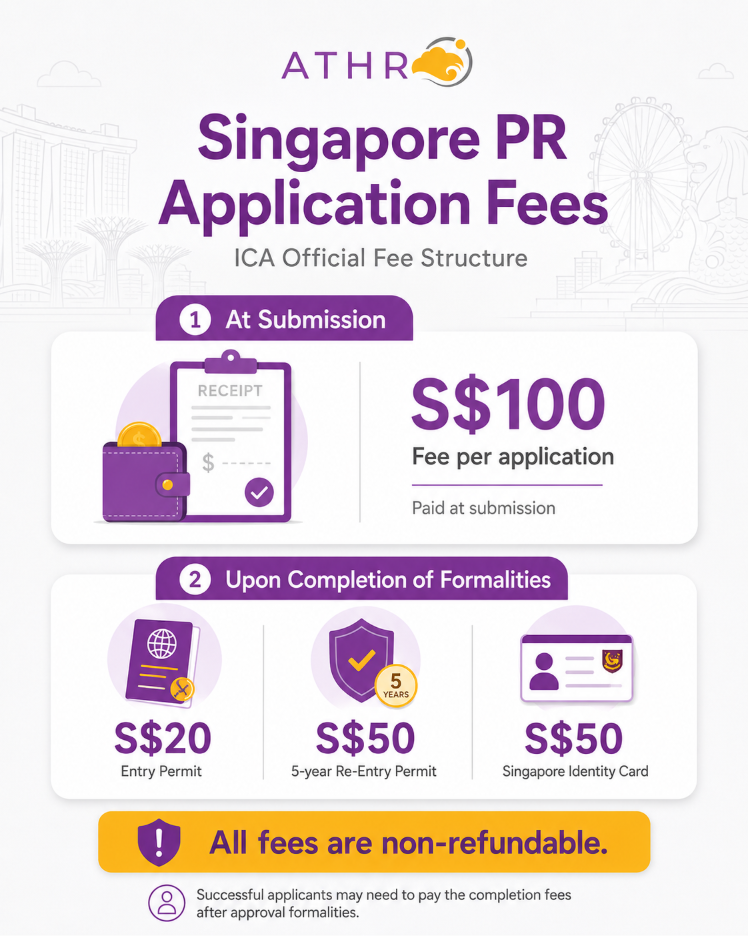
ICA’s official fee structure includes a S$100 fee per application at submission. Upon completion of formalities, successful applicants may need to pay S$20 for the Entry Permit, S$50 for a five-year Re-Entry Permit, and S$50 for the Singapore Identity Card. All fees are non-refundable.
Payment can be made online using supported credit or debit cards, internet direct debit, or PayNow.
How to Apply for PR in Singapore: Step-by-Step Guide
Step 1: Confirm Your Eligibility Category
Start by identifying the correct eligibility route. For most foreign professionals, this will be the EP or S Pass route. For spouses, children, aged parents, students, and investors, the sponsor or application process may differ.
Step 2: Prepare Your Documents
Gather all personal, employment, tax, education, family, and business documents before starting the application. Do not rely on outdated employer letters or incomplete financial records.
For non-English documents, prepare official translations early. ICA accepts translations provided by the issuing country’s embassy, a notary public, or privately translated documents that are properly attested or notarised.
Step 3: Submit Through ICA e-PR System
Applications are submitted online through the ICA e-Service. Applicants and sponsors must use Singpass where applicable. ICA also states that all persons added as applicants must review the application form and provide their declarations before submission.
Step 4: Wait for ICA Processing
ICA states that PR applications will be processed within six months, provided all required documents are submitted and in order. Some applications may take longer.
Step 5: Complete Formalities After Approval
Successful applicants will receive an In-Principle Approval. PR status is granted only after the applicant fulfils the required completion formalities.
Can You Get Singapore PR by Starting a Business?
Yes, starting a business can support a Singapore PR pathway, but it does not directly guarantee PR.
A foreign entrepreneur cannot simply incorporate a small company and receive PR. In most cases, the business owner first incorporates a Singapore company, applies for an Employment Pass through that company, runs genuine operations, pays themselves a commercially reasonable salary, files taxes, and later applies for PR under the PTS route.
This means the business must be real, active, and economically meaningful.
The Business Owner Roadmap
A typical business owner pathway may look like this:
Incorporate a Singapore private limited company
Apply for an Employment Pass through the company
Meet MOM’s salary and COMPASS requirements
Operate the business with real clients, revenue, and compliance records
Pay personal income tax in Singapore
Build a clear track record before applying for PR
What ICA May Expect From Business Owners
Business owners are often assessed with additional scrutiny because they control both the company and their own employment structure. A stronger profile may include local hiring, CPF contributions for Singaporean or PR employees, local vendor spending, office presence, business contracts, recurring revenue, corporate tax compliance, and proper accounting records.
A company that exists only on paper is unlikely to help. A real operating business with commercial activity, local contribution, and transparent records is much stronger.
GIP vs PTS: Which PR Route Applies to Entrepreneurs?
The Global Investor Programme is not the same as the ordinary business-owner-to-EP-to-PR pathway.
The GIP is intended for eligible global investors with substantial business track records. As of 2026, qualified investors may apply through options including investing at least S$10 million in a new or existing Singapore business entity, investing at least S$25 million in a GIP-select fund, or establishing a Singapore-based Single Family Office with at least S$200 million in assets under management, where at least S$50 million is deployed in EDB-specified investments.
For most SME owners and startup founders, the PTS pathway through an Employment Pass is more realistic than GIP.
Speak to ATHR about Singapore incorporation and business setup
When Should You Apply for Singapore PR?
Technically, an EP or S Pass holder may become eligible once they hold the relevant pass, but timing matters.
For many applicants, submitting too early can be a mistake. A short work history, limited tax record, incomplete payslip trail, or weak local integration may make the application look rushed.
As a practical rule, many applicants wait until they have at least one full tax assessment cycle and a stronger employment record. Business owners may need even more time to show that their company is stable, compliant, and contributing meaningfully to Singapore.
A stronger PR application is not just about eligibility. It is about readiness.
Common PR Application Mistakes to Avoid
Many applications are weakened by avoidable issues. These include missing documents, outdated employer letters, inconsistent payslips and CPF records, weak explanation of employment history, unclear business activity, poor tax compliance, and applying before the profile is mature.
Another common mistake is that assuming high salary alone is enough. ICA’s assessment is broader. Singapore is looking not only at economic value, but also integration, family roots, and long-term commitment.
For business owners, two mistakes are especially risky: incorporating a dormant company and underpaying yourself to reduce tax. Both may make the profile less credible.
Final Thoughts: A Strong Singapore PR Application Takes Planning
A Singapore PR application in 2026 should be treated as a strategic submission, not a rushed form-filling exercise.
The strongest applications usually tell a consistent story: you are working or operating a real business in Singapore, contributing economically, complying with tax and employment rules, integrating into society, and building a long-term future here.
For professionals, this means stable employment, proper income records, and complete documentation. For entrepreneurs, it means a genuine company with real revenue, local contribution, and transparent accounting.
Need Support With Your Singapore Setup Before PR Planning?
ATHR supports foreign founders, SMEs, and growing businesses with Singapore company incorporation, corporate secretary services, accounting, tax compliance, payroll, and Employment Pass support.
👉 If you are planning to build a stronger Singapore business presence before your PR application, ATHR can help you structure the right foundation from day one.
The ATHR Content Team is a group of professional writers from Singapore and the Philippines, committed to delivering informative, practical, and engaging content for business owners across Southeast Asia.
Free yourself from routine business tasks and let ATHR take the weight of financial administration off your shoulders. Smart solutions, seamless service, zero hassle.