To register a company in Singapore, you reserve a company name with ACRA (the Accounting and Corporate Regulatory Authority), gather the details of your directors and shareholders, file the application on Bizfile, and pay once everyone has approved it. This guide walks you through that process for a private limited company (Pte. Ltd.), the structure most founders choose. It covers what you need, the six steps, the fees, realistic timelines and the mistakes that cause delays.
Key Takeaways
To register a company in Singapore, you reserve a name, then file a Pte. Ltd. application online through ACRA's Bizfile. ACRA's fees total S$315 (S$15 for the name, S$300 for registration).
You need at least one director who is ordinarily resident in Singapore, one shareholder, a Singapore registered office address and a company constitution. A company secretary must follow within six months.
Only the person who reserved the name can file, and that person must be a director or the secretary.
Every other director, secretary and shareholder must endorse the application within 60 days, and payment is only requested after they do.
Singapore Incorporation at a Glance
The rules and figures here were checked against ACRA's published guidance as of 1 October 2026.
Who files
The person who reserved the name (a director or secretary), or a corporate service provider
ACRA fees
S$15 name reservation + S$300 registration = S$315
Typical time
Most applications are approved soon after payment; complex ones can take up to 15 working days
Longest delays
Names or businesses referred to other agencies (14 to 60 days for registration), and officers who are slow to endorse
Where it happens
Online, on Bizfile, using Singpass
What Does It Mean to Register a Company in Singapore?
Registering a company in Singapore means incorporating a private limited company (Pte. Ltd.) with ACRA. This creates a legal entity separate from its owners, with its own Unique Entity Number (UEN). You apply online through Bizfile and need at least one resident director and one shareholder.
A Pte. Ltd. can own assets, sign contracts and be sued in its own name. Its shareholders' liability is generally limited to the amount they have invested in their shares, which is the main reason founders choose it over a sole proprietorship, where the owner and the business are legally the same person. If you are still weighing the two, our comparison of a sole proprietorship versus a Pte. Ltd. covers the trade-offs.
Do you have to register at all?
If you carry on an activity for profit on a regular basis, yes, unless an exemption applies (see ACRA's requirements and eligibility page). The main exemption is narrow: a sole proprietor or partnership that trades only under the full NRIC names of its owners does not need to register a business name. A company never qualifies for that exemption, so if you want limited liability, registration is the only route.
Which type of company?
ACRA lists several company types, but most founders register one of two. A private company limited by shares can have up to 50 shareholders, including corporate shareholders. An exempt private company is limited to 20 individual shareholders. For a new business, the first is the usual starting point because it leaves room to bring in investors or partners later. The rest of this guide assumes a private company limited by shares.
What Do You Need Before You Register a Pte. Ltd.?
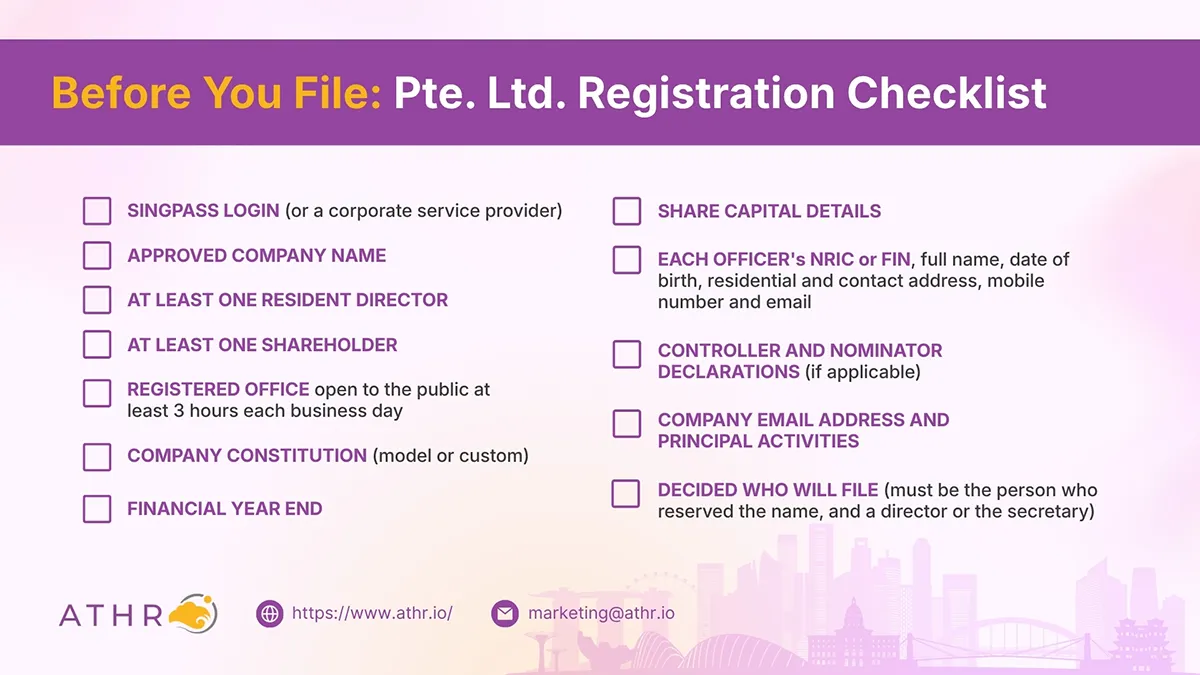
Before filing, you need a Singpass login, an approved company name, at least one resident director, at least one shareholder, a Singapore registered office, a company constitution, a financial year end and personal details for every officer. Having these ready is what keeps the filing to a single sitting.
Use this as a pre-filing checklist:
A Singpass login (or a corporate service provider). Individuals file with their own Singpass. Corporate service providers file with Corppass.
An approved company name. You reserve this first (Step 1 below).
At least one director who meets Singapore's residency rules. Directors must be 18 or older, ordinarily resident in Singapore and of sound mind. In practice this means a Singapore citizen, a Singapore permanent resident, or a pass holder who is eligible under ACRA's local-residency rules. ACRA tells FIN holders to check with their pass issuer before accepting a directorship.
At least one shareholder. A private company limited by shares can have up to 50. Shareholders can be individuals or companies, and one person can be both the sole director and the sole shareholder.
A registered office address. Under ACRA's registered office rules, this must be a Singapore address that is open and accessible to the public for at least three hours on each business day. It does not have to be where you run the business. Failing this can lead to a fine of up to S$5,000. (A P.O. box does not count.) Our guide to why your registered office address matters goes deeper, and if you are weighing a shared address, see virtual versus physical office options.
A company constitution. The rulebook for how your company is run (Step 5).
A financial year end (FYE). The date your company's accounting year closes.
Share capital details. How many shares, what currency, and who holds them.
Details for each officer and shareholder. NRIC or FIN, full name, date of birth, residential address, contact address, mobile number and email.
Controller and nominator declarations. If anyone holds shares or acts as director on behalf of someone else, or if there are registrable controllers, these must be declared.
A company email address and your principal activities. You are asked for these during the filing.
Practitioner's Note:
Decide who will file before you pay to reserve the name. ACRA only lets the person who reserved the name register the company, and that person must be appointed as a director or secretary. If the wrong person reserves it, you cannot simply hand the filing to someone else, and you would likely have to reserve the name again.
How to Register a Company in Singapore: 6 Steps
Each step below tells you what happens, what you need, who does it and how long it takes.
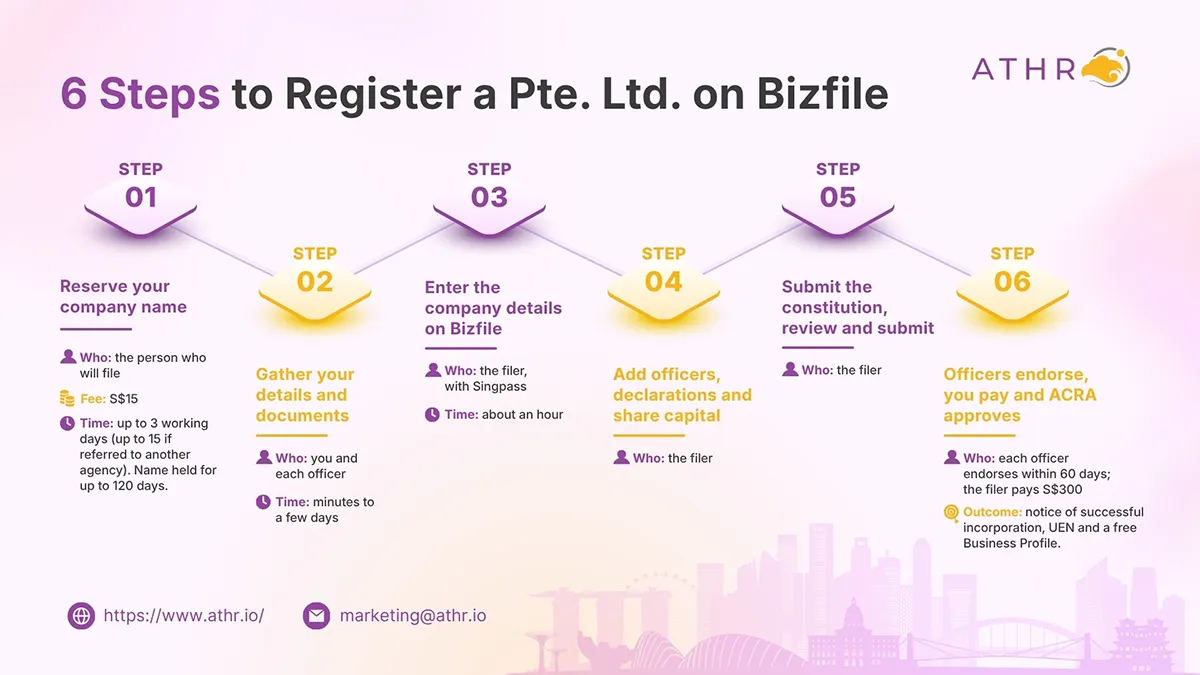
Step 1: Reserve Your Company Name
What happens: You check availability and apply for the name on Bizfile. The fee is S$15 and is non-refundable if the name is unavailable or you withdraw the application. Who: The person who will later file the registration. How long:ACRA reviews name applications in up to three working days, or up to 15 working days if the name is referred to another agency (this can happen with regulated words such as "bank" or "school"). Good to know: An approved name is held for up to 120 days. If you have not registered by then, it is released for others to use. A name that is identical to an existing one needs consent from its owner.
Step 2: Gather Your Details and Documents
What happens: Collect everything on the checklist above so you can complete the form in one go. Who: You, plus each director, shareholder and the company secretary (if appointed now).
How long: From a few minutes to a few days, depending on how quickly your co-founders send their details.
Step 3: Enter the Company Details on Bizfile
What happens: Log in with Singpass, choose "Register new business entity", enter your approved name's registration number and fill in the company details, including your FYE, principal activities, registered office address and company email.
Who: The person who reserved the name.
How long: Roughly an hour for a prepared first-time filer.
Step 4: Add Officers, Declarations and Share Capital
What happens: Add each director, the company secretary (if you are appointing one now) and the shareholders. Then declare any nominators and registrable controllers, enter the share capital (currency, payment mode, share classes) and allot shares to each shareholder. Who: The filer, using details from each person. How long: Part of the same sitting as Step 3.
Step 5: Submit the Constitution, Review and Submit
What happens: Upload your constitution (or adopt ACRA's model one), review everything, make the declarations and submit.
Who: The filer.
How long: Minutes, but check the review screen carefully. Errors here are what delay approvals.
Step 6: Officers Endorse, You Pay and ACRA Approves
What happens: Every other director, the secretary and the shareholders receive a notification and must endorse the application. Once all have done so, you receive a payment notification and pay the S$300 registration fee. You can choose a special UEN at this point, which may carry an extra fee. ACRA then sends the outcome to your Bizfile inbox: a notice of successful incorporation, your UEN and a link to download a free copy of your Business Profile.
Who: Each officer endorses; the filer pays.
How long: Endorsement must be completed within 60 days of submission. After payment, most registrations are approved soon after. Complex applications can take up to 15 working days, and those referred to another agency can take 14 to 60 days.
Good to know: If a corporate service provider files for you, the 60-day endorsement step does not apply.
Practitioner's Note:
Payment is only requested after everyone has endorsed. That means a co-director who is travelling or ignoring their email can hold up the whole registration. Tell each person to expect the notification, and ask them to endorse the same day. ACRA's deadline is 60 days, and an application that has not been fully endorsed by then will not go through.
You can change most of these later, but it is cheaper and simpler to get them right at the start.
Share Capital and Shareholders
The minimum share capital is S$1, and shares can be partly paid, as ACRA's share capital guidance explains. Many founders start small and increase capital later when a bank, a landlord or an investor asks for more. Think about who owns what before you file. Shareholding sets voting power and profit entitlement, and it is much easier to agree this at the start than to renegotiate it later.
Directors and Company Secretary
Directors carry legal duties, and ACRA offers a free, two-hour online Directors' Training Programme covering the basics. You need one resident director from day one. The company secretary must be appointed within six months of registration and must be a real person, not a company, and cannot be the same person as the sole director. If you are the only director, read whether a corporate secretary is required for single-director companies.
ACRA's model constitution works for many simple companies (see ACRA's constitution page). A custom constitution can add rules on share transfers, director appointments and decision-making, which matters more once you have several shareholders. Whichever you choose, keep a signed copy at your registered office.
Registered Office
Pick an address you can reliably keep. You can change it later, but the change has to be filed with ACRA, so it is simpler to start with one you will not need to move.
How Much Does It Cost to Register a Company in Singapore?
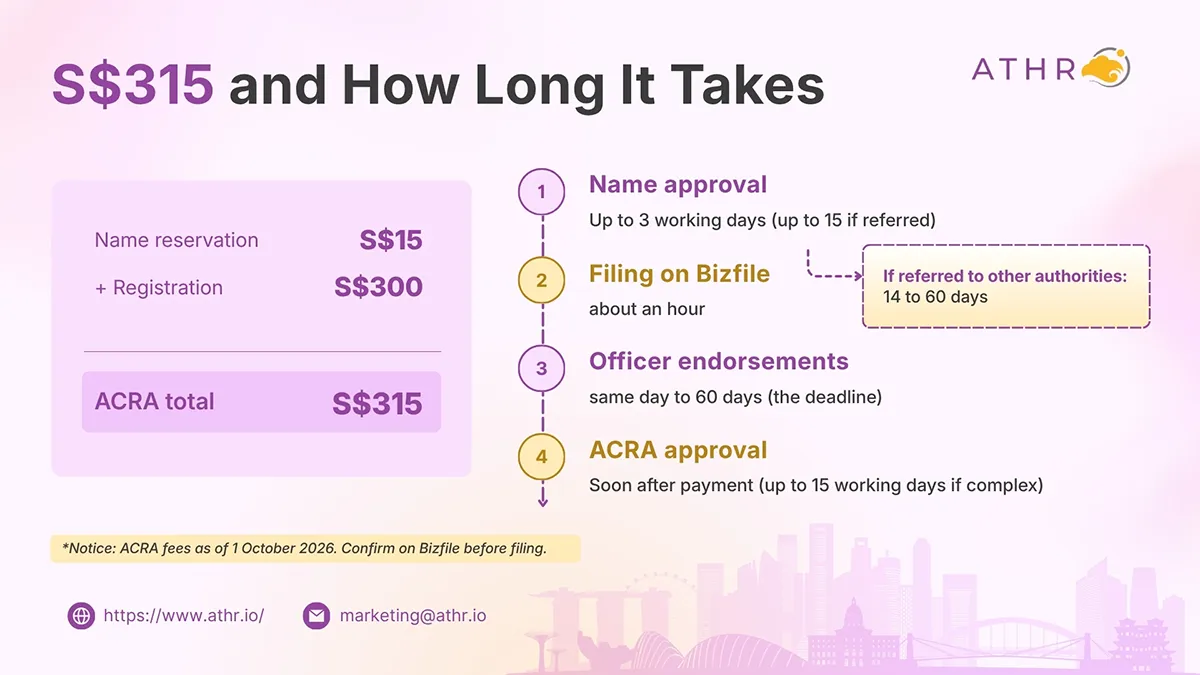
The ACRA government fees to register a Pte. Ltd. total S$315: S$15 to reserve the name and S$300 to register the company. A service provider's fee is additional, and you also need to budget for costs that start right after incorporation.
Item
Cost
When
Name reservation
S$15 (non-refundable if the name is unavailable or you withdraw)
Step 1
Company registration
S$300
Step 6
ACRA total
S$315
These fees are current as of 1 October 2026. They can change, so confirm them on ACRA's Bizfile pages on the day you file.
Beyond the government fees, plan for:
A company secretary, required within six months of incorporation.
A registered office address, if you do not have a suitable one of your own.
Accounting and bookkeeping, from the first day of trading.
A special UEN, only if you want one.
Professional help if you choose a service provider to file for you. Fees vary between providers, so ask for a clear written scope.
A simple budgeting formula: ACRA fees (S$315) + an address and secretary solution + first-year accounting.
How Long Does Company Registration Take?
Name approval takes up to three working days. Once you file and everyone endorses, most applications are approved soon after payment. Delays come from referral to other agencies, which can add 14 to 60 days, and from officers who endorse slowly.
Stage
Typical time
Name approval
Up to 3 working days (up to 15 if referred)
Preparing details
Minutes to a few days
Filing on Bizfile
About an hour
Officer endorsements
Same day to 60 days (the deadline)
ACRA approval after payment
Soon after payment; up to 15 working days if complex
If referred to other authorities
14 to 60 days
What makes it longer: regulated business activities, names that contain restricted words, missing officer details and slow endorsements. If your business needs another agency's approval, such as a financial or education business, ask early about timing.
Common Mistakes When Registering a Company
Letting the name lapse. The 120-day hold is firm. Fix: Gather your details before you reserve, so you file well within the window.
The wrong person files. Only the person who reserved the name can register. Fix: Decide the filer first (see the Practitioner's Note above).
Officers who do not endorse. The application cannot proceed past the 60-day deadline. Fix: Warn each person and follow up the same day.
An unusable registered office. An address that is not open for at least three hours on business days can attract a fine of up to S$5,000. Fix: Confirm the address's opening hours before you file.
Choosing the FYE casually. It determines your later deadlines. Fix: Choose it deliberately, with your accounting calendar in mind.
Registration gives your company legal existence, but you are not ready to trade until a few more things are in place (ACRA keeps a post-registration guide for local companies):
Download your Business Profile from Bizfile (free via the link ACRA sends you). Banks and counterparties commonly ask for it.
Set up Corppass so your company's authorised people can use government e-services.
Check licences and permits. ACRA registration is separate from industry licences. The GoBusiness Licensing portal lists what your activity needs, such as food, financial services, healthcare or education licences.
Open a corporate bank account. Compare account fees, transaction limits and international transfer costs.
Appoint your company secretary within six months, and an auditor within three months unless your company is exempt.
Notify ACRA of changes to officers within 14 days of the change.
Should You Register It Yourself or Use a Service Provider?
There are three routes, and none is wrong. It depends on how much time you have and how simple your setup is.
Route
Best for
Watch out for
File it yourself with Singpass
A resident founder with a simple setup and time to learn Bizfile
You carry the filing risk; officers must endorse within 60 days
A registered filing agent
Founders who want the form completed correctly
Scope is limited to the filing itself; ask what is and is not included
A full-service corporate service provider
Founders who also need a secretary, address, accounting or nominee support
Check exactly what is bundled and what is billed separately
One rule to know: ACRA requires foreign individuals to use a corporate service provider to reserve a name and register a company. Read more in our guide to ACRA filing agents.
Frequently Asked Questions About Incorporating in Singapore
What is the minimum capital to register a company in Singapore?
The minimum share capital is S$1. Many companies start with more because banks, landlords and investors often expect a more substantial figure, but ACRA does not set a higher legal minimum for a private company.
Can I register a company in Singapore if I live overseas?
You need at least one director who is ordinarily resident in Singapore, and foreign individuals must use a corporate service provider to reserve the name and register. Many overseas founders appoint a nominee director. The route for foreign founders is covered in more depth in a separate guide.
Can I be the only director and the only shareholder?
Yes. A private company limited by shares needs at least one director and at least one shareholder, and one person can be both. If you are the sole director, you cannot also be the company secretary.
Do I need a company secretary when I register?
Not on day one. You must appoint one within six months of registration. The secretary must be a real person and cannot be the same person as the sole director.
What document proves my company exists?
ACRA's registration outcome includes a notice of successful incorporation, your UEN and a link to a free Business Profile. ACRA's registration page does not list a "certificate of incorporation". If a bank or counterparty asks for one, ask what they need it for, as the Business Profile is usually what shows your company's details.
Can I use my home address as the registered office?
ACRA only requires that the address is in Singapore and open and accessible to the public for at least three hours on each business day. Many homes cannot meet that, and housing and zoning rules may restrict business use, so check the rules for your property type before you file.
What if ACRA does not approve my company name?
The S$15 fee is non-refundable if the name is unavailable, so check availability carefully first. Choose a different name and apply again. Names that are too similar to an existing one, or that contain restricted words, are the usual causes.
How ATHR Can Help
Registering the company is only the first stage. If you would like someone to check your name, officers, address and constitution before you file, or to handle the Bizfile submission and endorsements for you, ATHR can support the incorporation and the setup that follows.
It helps to bring the following when you get in touch: your preferred company names, the names and roles of your directors and shareholders, where you plan to keep the registered office, and your intended business activities. Our team can then tell you what applies to your situation.
The ATHR Content Team is a group of professional writers from Singapore and the Philippines, committed to delivering informative, practical, and engaging content for business owners across Southeast Asia.
Free yourself from routine business tasks and let ATHR take the weight of financial administration off your shoulders. Smart solutions, seamless service, zero hassle.