Which SSIC code should you pick? Can you change it later? And will the wrong one delay your registration?
An SSIC code is the five-digit code from the Singapore Standard Industrial Classification that ACRA asks you to give for your business activity. ACRA, the Accounting and Corporate Regulatory Authority, is the agency that registers and regulates Singapore businesses. You enter the code when you reserve a name, and you update it when the business changes.
This guide explains how primary and secondary activities work and how to search for the right code. It also covers when a code triggers approval from another agency and how to change it on Bizfile. It is written for first-time founders and for foreign founders who register through a corporate service provider.
Key Takeaways
ACRA says every registered entity classifies its business with five-digit SSIC codes: one primary code is required and one secondary code is optional.
Your code can send an application to another government agency for approval. ACRA gives 71111 and 68201 as examples, and a referral can take up to 15 working days.
Update your business activity on Bizfile within 14 days of a change, or within 30 days for a foreign company. The update is free.
Choose the code that best describes what the business does, because ACRA sets no other test. The SingStat report adds that the principal activity is the one that contributes the most value added.
SSIC Codes in Singapore at a Glance
The table summarises the main rules as of November 2026, based on ACRA and SingStat pages.
Item
What to know
Who needs one
Every ACRA-registered entity
Codes allowed
One primary code (required) and one secondary code (optional)
Cost to change
Free on Bizfile, processed immediately
Update deadline
14 days from the change, or 30 days for foreign companies
Late penalty for companies
S$50 within three months, S$200 beyond three months
Biggest risk
A code that triggers a referral, or one that no longer describes the business
What Is an SSIC Code?
An SSIC code is a five-digit number from the Singapore Standard Industrial Classification, which ACRA uses to classify business activities. All ACRA-registered entities must use these codes for their primary activity and, where relevant, a secondary activity.
ACRA's SSIC page describes the SSIC as Singapore's system for classifying business activities, updated by the Department of Statistics (SingStat) every five years. The classification has 22 broad sections, each marked by a letter, and the five-digit code is the most detailed level. The first two digits give the division, such as division 68 for real estate activities.
The code describes what the business does. SingStat's SSIC 2025 report says the code does not depend on ownership, the type of legal organisation or the mode of delivery. A company that sells clothes only online sits with firms that sell clothes in shops.
Plain-English: A referral authority is a government agency that must approve certain business names or activities before ACRA completes your registration. Later sections explain when your code triggers one.
Which Situation Are You In?
Your situation decides what you do. A new business chooses codes when it reserves a name, while an existing business checks its code and updates it within 14 days of a change.
The table matches common situations to the action to take.
Your situation
What to do
You are registering a new company or business
Choose one primary code, and one optional secondary code, when you reserve the name
You have not started trading yet
Choose the code for the activity you intend to carry out
You started a second line of business
Add a secondary code on Bizfile, or file through General Lodgement if you already have two
Your main activity has changed
Update the primary code within 14 days
You run a foreign company branch
Update the activity within 30 days of the change
Find your row, then follow the matching section below.
Picture a founder who opens a design studio and later adds a paid online course. The studio starts with a design code as primary. If the course later brings in more than the design work, the primary code no longer describes the business, and the founder updates it on Bizfile within 14 days.
SingStat's classification rules treat a business that has not started operating by its intended activity, not its preparation work. A new founder can choose the code for the business they plan to run.
Comparing primary, secondary and ancillary business activities
What Is the Difference Between a Primary and a Secondary Activity?
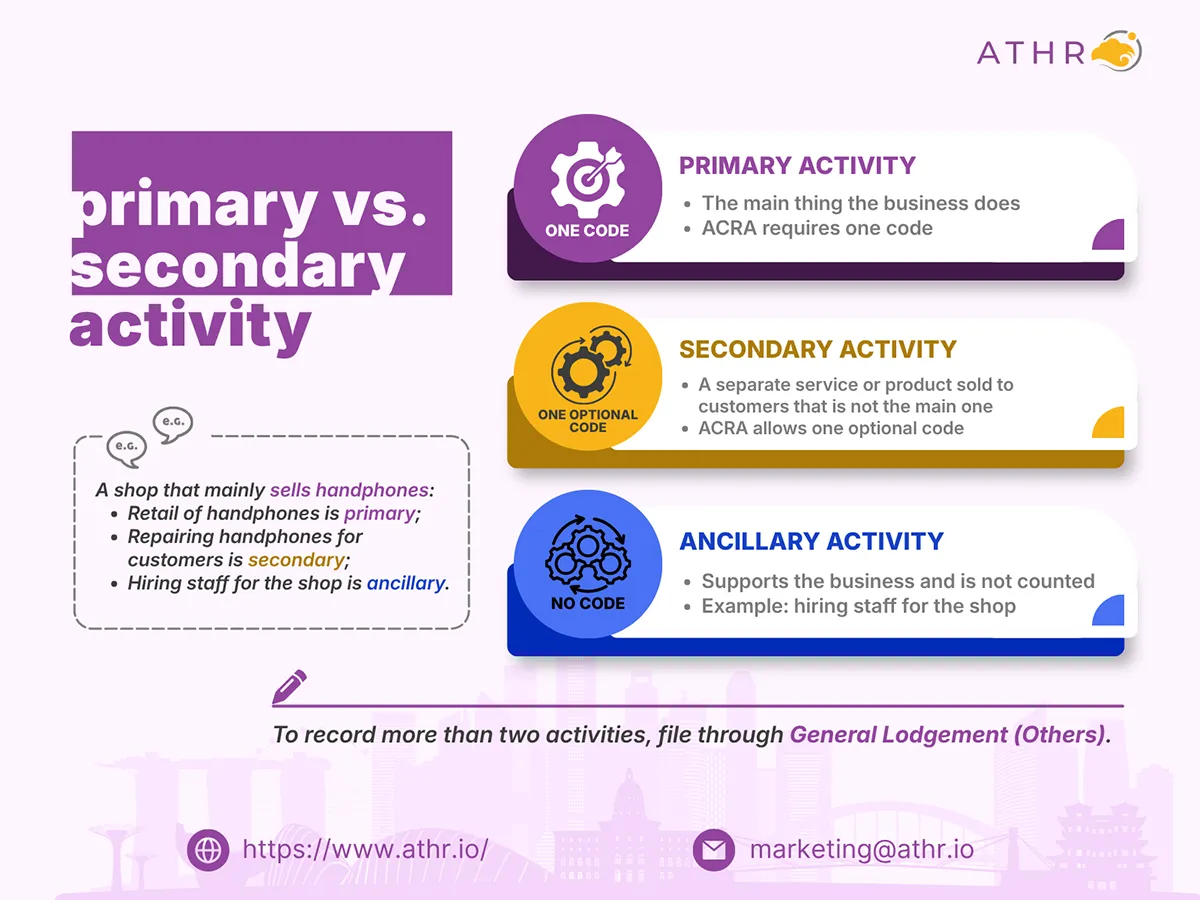
Your primary activity is the main thing the business does, and ACRA requires one code for it. Your secondary activity is a separate service or product sold to customers that is not the main one, and ACRA allows one optional code for it.
ACRA asks you to select codes that "best describe your business activities" and gives no further test. SingStat's SSIC 2025 report fills the gap. It defines the principal activity as the one that contributes the most value added. Value added is the value of what the business produces minus the cost of the inputs it uses. Where value added is hard to measure, it accepts substitutes such as sales, wages or hours worked.
In practice, compare which activity brings in the most sales. The report gives a simple example. A shop whose largest activity is retail sale of handphones has that as its principal activity, and repairing handphones for customers is a secondary activity. Hiring staff for the shop is an ancillary activity, which supports the business and is not counted.
ACRA allows one primary and one optional secondary code. To record more than two activities, the Bizfile guide says to file through the General Lodgement (Others) eService and include the SSIC code for each activity.
Five steps for finding the right SSIC code
How Do You Find the Right SSIC Code, Step by Step?
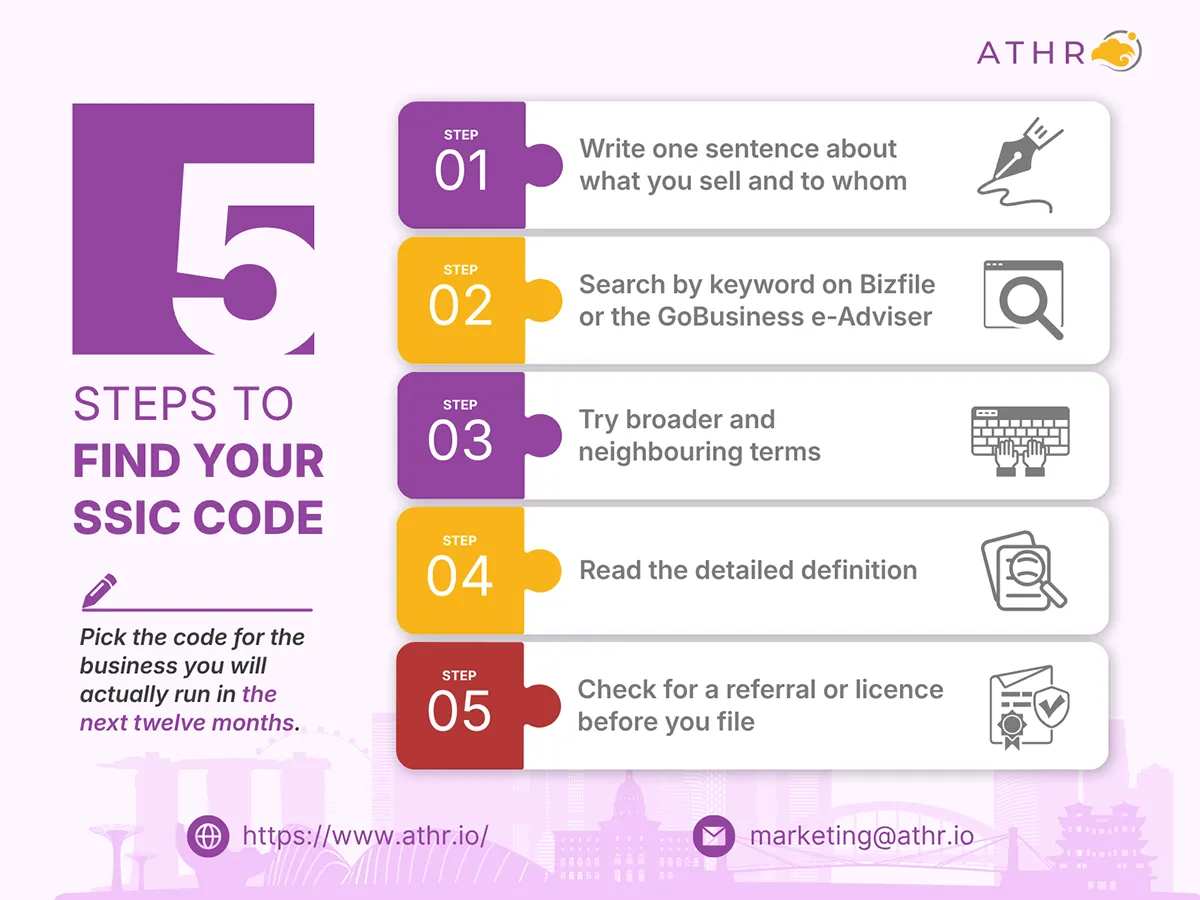
Describe the business in one sentence, search for it on Bizfile or the GoBusiness e-Adviser, test close alternatives, then check the code's definition and referral status before you file.
SingStat's report names two ways to find a code. You can search the alphabetical index for the activity, including synonyms, and confirm the code in its detailed definition. Or you can start from the broad section and narrow down to the five-digit code, confirming the choice in the definition. The steps below combine both.
Step 1: Write one sentence about what you sell and to whom. Include the product or service and the customer, such as "we design websites for small restaurants". Everything else in the search starts from this sentence.
Step 2: Search by keyword. On Bizfile, enter a keyword under "Business activity" and select Search. ACRA recommends the GoBusiness e-Adviser as a way to prepare before you apply, since it includes SSIC code searching.
Step 3: Try broader and neighbouring terms. If your exact words return nothing, search the wider activity ("software", "consultancy") and read the neighbouring codes. SingStat's alphabetical index lists alternative titles for each activity, so a synonym often finds the right code.
Step 4: Read the detailed definition. SingStat's detailed definitions list what a code includes and what it excludes, with a pointer to the code that fits an excluded activity. A code ending in 9 and marked "n.e.c." means "not elsewhere classified", so use it only after you have checked the closer codes.
Step 5: Check for a referral or licence before you file. Compare your name, code and activity against ACRA's referral authorities page, covered in the next sections, so a regulated code does not surprise you after you have filed.
Practitioner's Note:
Pick the code for the business you will actually run in the next twelve months, not the widest code that could cover every idea. A narrow, accurate code keeps your Bizfile record true and keeps you from triggering a referral for an activity you have no plan to carry out yet.
Who Registers the SSIC Code if You Are a Foreigner?
ACRA says foreigners must engage a corporate service provider (CSP) to reserve a name and register a business structure. The provider enters your SSIC codes during that filing, but the choice of code remains yours. The rule appears on ACRA's requirements page.
A CSP is a business that provides corporate services to others, such as company registration and filing. Because the code is entered at name reservation, a wrong code can slow the whole registration. This is where an experienced provider helps most.
After registration, the follow-through matters too. ACRA's post-registration guide says to appoint a company secretary within six months. ACRA's company update guide says directors and secretaries must report changes such as a new business activity. A corporate secretary who knows Singapore's compliance rules keeps those filings on time. ATHR's guide to registering a company as a foreigner explains the route in full.
Will Your SSIC Code Trigger a Referral to Another Agency?
Yes, it can. ACRA says a referral can be triggered by your business name, SSIC code or business activity. A referred application may take up to 15 working days to review.
ACRA's referral authorities page says your registration "may need approval from another agency", which can add to processing time. The table gives ACRA's own examples.
Trigger
ACRA's example
Referred to
Name
A name containing "architect"
Board of Architects Singapore
Name
A name containing "law" or "legal"
Ministry of Law
SSIC code
71111 (architectural services)
Board of Architects Singapore
SSIC code
68201 (real estate agencies and valuation services)
Council for Estate Agencies
Business activity
Operating a school or training centre for academic education
Ministry of Education
Business activity
Spot commodity trading
Enterprise Singapore
ACRA lists 14 referral authorities in total, including the Monetary Authority of Singapore, the Singapore Food Agency and SkillsFuture Singapore. Check the full list before you file.
Practitioner's Note:
The referral can come from the code even when the name looks harmless. A neutral company name can still be referred if its code points to a regulated activity. Compare the name, the code and the activity description against ACRA's list before filing, so the 15 working days do not surprise you.
A referral is about approval, not about the code alone. If you need a licence to operate, the GoBusiness licence e-Advisers help you find it by sector.
How Do You Check or Change Your SSIC Code After Registration?
You change your SSIC code on Bizfile through Corppass, and ACRA says to update entity information within 14 days of a change. The change is free and processed immediately, and authorised officers or a corporate service provider can file it.
ACRA's Bizfile guide sets out the steps, and the same page shows your current code.
Step 1: Log in as a Business User. Use Corppass, open the entity's dashboard and select "View entity details".
Step 2: Open Business activities. On the entity information page, choose "Business activities" and select "Edit".
Step 3: Enter the new code. Type the SSIC code, or search by keyword and choose the activity from the list.
Step 4: Set the effective date. Enter the date the change took effect. To add a secondary activity, select "Add secondary business activity".
Step 5: Review and confirm. You see a confirmation message and a notification in your Bizfile inbox.
The deadline is 14 days from the date of change for all registered entities, and 30 days for foreign companies. The late lodgement penalties page sets the amounts for companies. They are S$50 if the filing is within three months late and S$200 if it is more than three months late, for due dates from 9 December 2024. Annual return penalties are separate.
Practitioner's Note:
The effective date field is the date the new activity truly began, not the date you file. Record the date in your board minutes when the change happens, so the 14 days are easy to count and the Bizfile entry matches your records.
What Changed With SSIC 2025?
SingStat published SSIC 2025 in April 2025 as an update of SSIC 2020. A Singpass partner support notice of 25 February 2026 announced changes to SSIC activity codes from 9 May 2026, so check your Bizfile record rather than assuming the code still fits.
SingStat's SSIC 2025 report says the classification is usually reviewed and updated every five years. Singpass's notice carries the 9 May 2026 date. The main changes are:
Fewer codes overall: There are 988 five-digit codes in SSIC 2025, against 1,023 in SSIC 2020, with around 50 obsolete codes removed or merged.
New codes for new activities: Examples include carbon capture activities, alternative proteins and concert organisers.
A split section: The old Information and Communications section became two, one for publishing, broadcasting and content production, and one for telecommunications, computer programming, consultancy and computing infrastructure.
Moves between sections: Childcare centres that provide pre-primary education moved from social services to education.
Clearer guidance: Detailed definitions for about 370 codes were enhanced, and more than 1,900 new titles were added to the alphabetical index.
ACRA's referral page was last updated on 9 May 2026, and ACRA's SSIC page does not name a version. If your business sits in a section that was split or reworded, search the current list and confirm the code.
Common Mistakes When Choosing an SSIC Code
Choosing a code from the business name. The name rarely matches the classification. Search by what the business does, and read the detailed definition before you pick.
Choosing the widest code to cover every idea. An over-broad or regulated code can trigger a referral and leaves your record inaccurate. Choose the activity you will actually carry out.
Ignoring the referral list. ACRA says referrals can come from the name, the code or the activity. Check all three before you file.
Missing the 14-day update. A change of main activity is a change to entity information. File within 14 days, or 30 days for a foreign company, to avoid a late lodgement penalty.
Using an out-of-date code list. SSIC 2025 restructured several sections of SSIC 2020, so a list or blog post written before 2026 may be out of date. Use the Bizfile search or SingStat's current documents.
Frequently Asked Questions About SSIC Codes
Can I have more than two SSIC codes?
Yes, but the Bizfile entity screen holds one primary and one optional secondary code. To add more activities, ACRA's guide says to file through the General Lodgement (Others) eService and include the SSIC code for each activity.
Is there a fee to change my SSIC code?
No. ACRA's Bizfile guide says the update is free and processed immediately. A corporate service provider may charge its own fee if it files the change for you, so ask for the scope in writing.
Do I need an SSIC code for a one-person company?
Yes. ACRA says all ACRA-registered entities must use SSIC codes to classify their business activities. The number of owners does not change the rule.
What if my activity is not in the list?
Search for the nearest activity and read the detailed definition. SingStat marks residual categories as "not elsewhere classified" and ends their codes in 9, so use one only after the closer codes have been ruled out. Ask your corporate service provider if you are unsure.
Can a foreign company branch have an SSIC code?
Yes. ACRA's Bizfile guide gives foreign companies 30 days from the date of change to update their business activity, against 14 days for other entities.
How soon must I update my code after the business changes?
Within 14 days of the change, or 30 days for a foreign company. ACRA's late lodgement penalties for companies are S$50 within three months and S$200 beyond three months.
Does my SSIC code decide whether I need a licence?
Not by itself. The code can trigger a referral to an agency such as the Council for Estate Agencies. Whether you need a licence depends on the activity, so check the GoBusiness licence e-Advisers by sector.
How ATHR Can Help
Start by telling us what the business sells, who the customers are, who will own it and where the owners live. That shows which SSIC code fits, whether a referral is likely and who must be the resident director.
ATHR prepares and files company incorporations for local and foreign founders, and ACRA requires foreigners to register through a corporate service provider. Our corporate secretary service then follows through, so later changes such as a new business activity are filed within ACRA's deadlines. A dedicated key account manager and the ATHR platform track each date.
The ATHR Content Team is a group of professional writers from Singapore and the Philippines, committed to delivering informative, practical, and engaging content for business owners across Southeast Asia.
Free yourself from routine business tasks and let ATHR take the weight of financial administration off your shoulders. Smart solutions, seamless service, zero hassle.