Can you register a company from overseas? Do you need a Singapore partner or a Singapore address? And is a company even the right structure, or would a branch suit you better?
Registering a company in Singapore as a foreigner follows the same rules as for residents, with two differences. ACRA requires foreigners to engage a corporate service provider (CSP) to reserve the name and register, and the business needs a locally resident person to answer for it. ACRA, the Accounting and Corporate Regulatory Authority, is the agency that registers and regulates Singapore businesses.
Key Takeaways
ACRA states that foreigners must engage a corporate service provider to reserve a name and register, so your first decision is who files for you.
Every route needs a locally resident person: one director for a company, or one authorised representative for a branch.
ACRA lists four routes for foreign businesses: a local company, a foreign company branch, a representative office and re-domiciliation.
A local company and a re-domiciled company have limited liability, while a branch and a representative office leave the parent fully responsible.
Singapore Setup for Foreigners at a Glance
The table summarises the rules and costs as of October 2026, based on ACRA, GoBusiness and MOM pages.
Item
What to know
Who files
A corporate service provider, for foreigners and for all foreign businesses
Local resident
One director for a company, one authorised representative for a branch
Government fees
S$15 name reservation, S$300 registration, S$985 re-domiciliation, S$200 a year for a representative office
Typical time
Most registrations approved soon after payment, up to 15 working days if complex, 14 to 60 days if a referral authority must approve
Biggest delay risk
Referral approvals for regulated activities, and incomplete documents
Which Route Fits Your Situation?
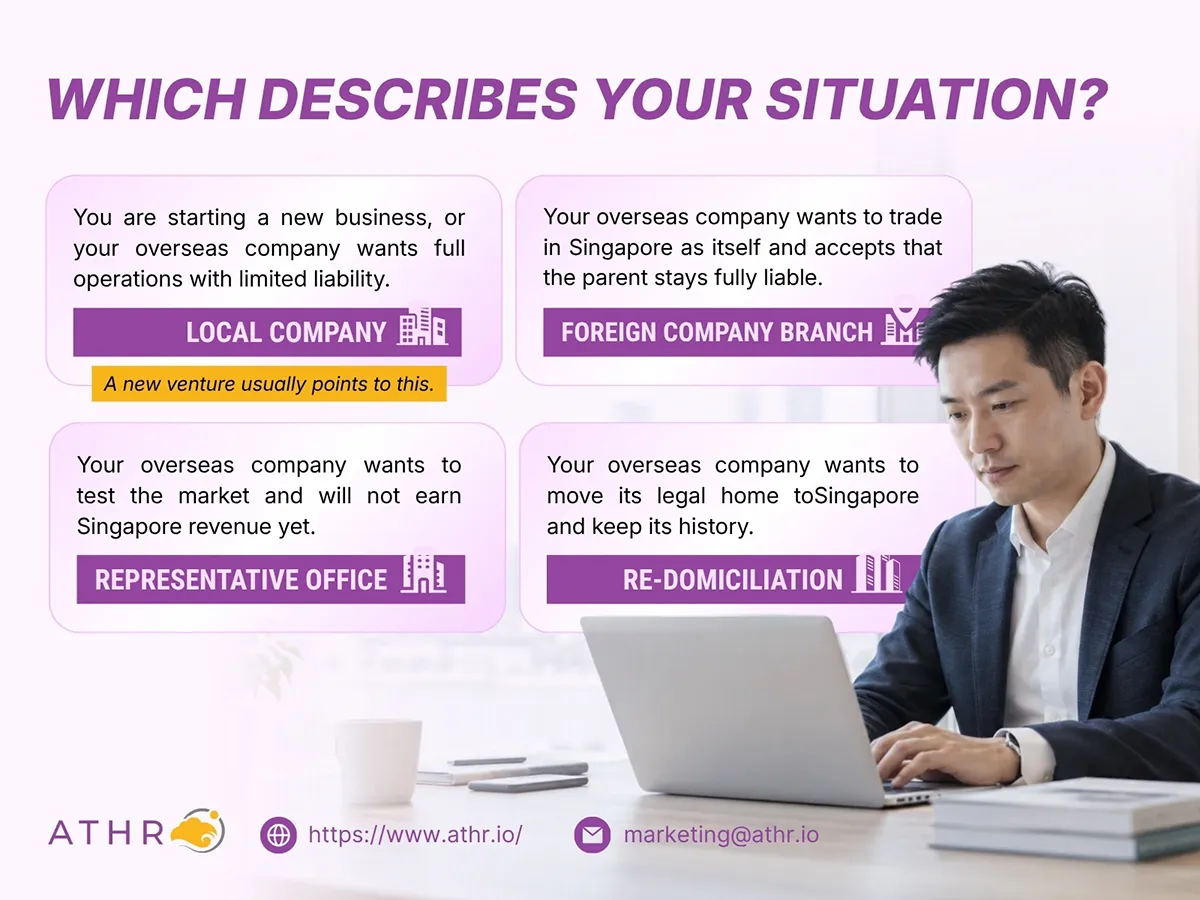
Your situation points to one of four routes. The table matches each common situation to the route that usually fits.
Your situation
Route that usually fits
You are starting a new business, or your overseas company wants full operations with limited liability
Local company
Your overseas company wants to trade in Singapore as itself and accepts that the parent stays fully liable
Foreign company branch
Your overseas company wants to test the market and will not earn Singapore revenue yet
Representative office
Your overseas company wants to move its legal home to Singapore and keep its history
Re-domiciliation
Imagine a trading company in Vietnam that wants Singapore customers. A representative office cannot earn revenue, so the choice is a branch or a local company. The local company keeps the parent's assets apart from Singapore liabilities, while the branch keeps the operation part of the parent but leaves the parent fully liable.
A new venture usually points to a local company.
Can Foreigners Register a Company in Singapore?
Yes. A foreigner can register a Singapore company through a corporate service provider, and ACRA's shareholding guidance sets no nationality condition. The company needs at least one director who meets ACRA's local residency rules, and the same CSP rule applies to every structure a foreign business registers.
ACRA's guidance says a company can have individual shareholders and corporate shareholders, so a foreign individual or a foreign company can own it.
Why Do Foreigners Need a Corporate Service Provider?
ACRA's requirements page says foreigners "must engage a Corporate Service Provider (CSP) to reserve a name" and register a business structure. Its foreign business page applies the rule to every structure: all foreign businesses must engage a CSP.
A CSP is a business that provides corporate services to others, such as company registration, registered address services and filing. The CSP files for you using Corppass, the digital login that companies and CSPs use for government services. Under the Corporate Service Providers Act, which took effect on 9 June 2025, providers had to register with ACRA by 9 December 2025, according to ACRA's CSP guidance.
The CSP handles the filing, but the decisions and the legal responsibility stay with you. ACRA's page does not define "foreigner", so a pass holder with a Singpass should ask ACRA or a registered CSP how the rule applies before filing alone.
Watch out: ACRA says a provider that fails to register cannot lawfully provide corporate services, and conviction can bring a fine of up to S$50,000. Confirm that your provider is registered before you pay a deposit. ATHR's guide to ACRA filing agents explains what they do.
Practitioner's Note:
Delays often come from officers who never see the endorsement request. ACRA says the 60-day endorsement by other position holders is not required when a CSP files the application. For an overseas team across time zones, the CSP route removes a common source of delay.
Which Local Resident Does Your Business Need?
Every route needs a person in Singapore who answers for the business, but the role differs by route. ACRA's requirements page says every business needs at least one local resident, and that different structures need them for different roles.
Local company: at least one director who meets ACRA's local residency rules at registration.
Foreign company branch: one authorised representative who meets the local residency requirements.
Representative office: a Corppass administrator with a valid NRIC or FIN, or a local third-party proxy who applies on your behalf.
Re-domiciliation: the company becomes a Singapore company, so the rules for a local company apply after the transfer.
Plain-English: An authorised representative is the person in Singapore who answers for a branch. ACRA warns that this person can be held personally responsible if the company does not meet its legal requirements.
ACRA counts Singapore citizens, permanent residents, and valid holders of an Employment Pass, Personalised Employment Pass or Overseas Networks and Expertise (ONE) Pass as local residents. Without one of these, a nominee director is one option, and nominee directors have the same legal duties as any director under ACRA's directors' duties guidance. ATHR's nominee director guide explains the fees, duties and limits.
What Are the Four Ways to Set Up a Foreign Business in Singapore?
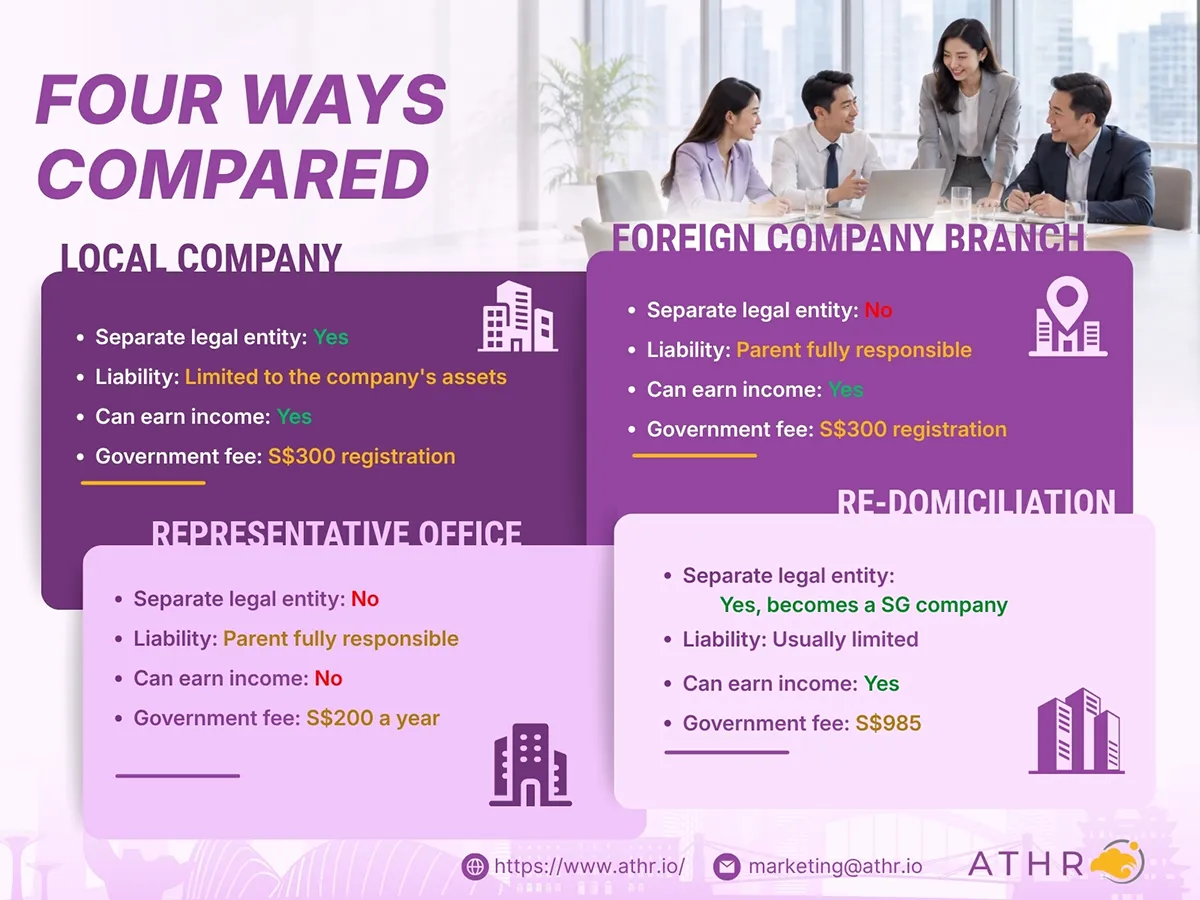
ACRA names four routes for foreign businesses: a local company, a foreign company branch, a representative office and re-domiciliation. Re-domiciliation is also called a transfer of registration, and the four differ in legal status, liability and permitted activity. The table compares them using ACRA's ways to set up page.
Route
Separate legal entity
Liability
Can earn income
Government fee
Local company
Yes
Limited to the company's assets
Yes
S$300 registration
Foreign company branch
No
Parent fully responsible
Yes
S$300 registration
Representative office
No
Parent fully responsible
No
S$200 a year
Re-domiciliation
Yes, becomes a Singapore company
Usually limited
Yes
S$985
Liability and income decide most choices, so find your row, then read that route's section.
Option 1: Local Company
A local company is a separate Singapore company owned by the foreign parent or by an individual. It can run full commercial operations, pays corporate tax, and limits liability to the company's assets. Choose it for a new venture or when you want to keep the parent's assets apart.
The catch is that it carries the full set of local company obligations from the start, covered later in this guide. It needs a director who meets the residency rules and a registered office open to the public for at least three hours on each business day. The fine for breaching that rule can reach S$5,000, according to ACRA.
Option 2: Foreign Company Branch
A branch is a direct extension of the foreign company, not a separate entity, so the parent is fully responsible for what the branch does. It can earn income. Choose it when the parent wants to trade in Singapore as itself and accepts that liability.
ACRA's branch page requires one authorised representative, certified copies of the parent's certificate of incorporation and constitution, and certified English translations of other-language documents. The registration fee is S$300. ACRA notes that a branch is not a Singapore tax resident unless the foreign company is controlled and managed in Singapore. Take tax advice on how branch profits are taxed.
Option 3: Representative Office
A representative office is a temporary presence for market research and feasibility studies. It is not a separate legal entity, cannot earn income and is not subject to corporate tax, and the parent is fully responsible. It is licensed through EnterpriseSG on the GoBusiness licence page.
GoBusiness sets these conditions for a commercial office. The foreign entity needs sales turnover of at least US$250,000 and at least three years of operation, and the office may have no more than four staff. The licence runs one year at a time for a maximum of three years, with an annual fee of S$200 and estimated processing of 14 working days.
Practitioner's Note:
Plan the exit on day one. GoBusiness says an office that wants to stay beyond three years should register its operations with ACRA. Start that application well before the licence ends, because the office cannot earn revenue in the meantime.
Option 4: Re-Domiciliation (Transfer of Registration)
Re-domiciliation moves a foreign company's legal home to Singapore. It becomes a Singapore private company limited by shares and keeps its history, contracts, assets and liabilities. It suits a parent that wants to become a Singapore company, not add one.
ACRA's re-domiciliation page sets these tests. The company must meet two of three size tests (assets over S$10 million, revenue over S$10 million, or more than 50 employees). It must be able to pay its debts for 12 months after applying, and it must be allowed to transfer under its home law. It must also have passed its first financial year end at home. The fee is S$985, and processing takes 40 working days from a complete submission, plus up to 15 if a referral authority reviews it.
Practitioner's Note:
The work continues after approval. ACRA requires existing charges to be registered within 30 days and proof of deregistration in the home jurisdiction within 60 days. If proof is late, ACRA may cancel the Singapore registration. An extension costs S$200 per application and grants 60 days, but you must apply before the current deadline passes.
ACRA also lists limited partnerships and limited liability partnerships as other structures. This guide covers the four routes above.
How Do You Register a Company in Singapore as a Foreigner, Step by Step?
The steps suit a local company or a branch, with notes where the other routes differ. They sit alongside the Pte. Ltd. detail in part 1.
Step 1: Choose your route and confirm the local resident. Use the decision table above, then confirm who will be your resident director or authorised representative. The filing cannot proceed without that person's details.
Step 2: Engage a corporate service provider. The CSP confirms the document list for your route and files for you. Agree the scope in writing, including the name, the registered address and the post-registration filings.
Step 3: Reserve the name. Your CSP applies through ACRA, which charges S$15 (non-refundable if the name is unavailable or you withdraw it). ACRA reviews the name in up to three working days, and names sent to referral authorities take up to 15 working days.
Step 4: Prepare documents and officer details. Every position holder gives a residential address, and any contact address must be in the same country and cannot be a P.O. box. For a branch, ACRA's page words the timing as certifying the parent's documents at least four months before you apply, unless ACRA approves otherwise. Confirm the dates with your CSP before the notary stamps anything.
Step 5: Your CSP files and ACRA reviews. A company or branch is filed through Bizfile, ACRA's online portal, and a representative office is applied for through GoBusiness. Re-domiciliation uses Bizfile General Lodgement. The timelines are in the next section.
Step 6: Complete the follow-ups.ACRA's post-registration guide says to apply for Corppass one day after you receive your UEN, the unique entity number ACRA gives your business. Appoint a company secretary within six months and an auditor within three months, unless exempt. A company can open a corporate bank account immediately after registration.
How Much Does It Cost and How Long Does It Take?
Government fees are fixed and published, while provider fees vary by scope. The table lists the government fees as of October 2026.
Item
Government fee
Name reservation
S$15, non-refundable if the name is unavailable or withdrawn
Local company registration
S$300
Foreign company branch registration
S$300
Re-domiciliation
S$985, non-refundable
Representative office
S$200 annual fee
Ask each provider for a written quote that states what is included:
Which government fees the quote covers.
Whether the registered address and company secretary are in the first-year price.
Whether a nominee director or authorised representative is included, and its renewal fee.
The charge for later changes and annual filings.
For a first-year budget, add the government fees, the provider package and the ongoing compliance costs described below.
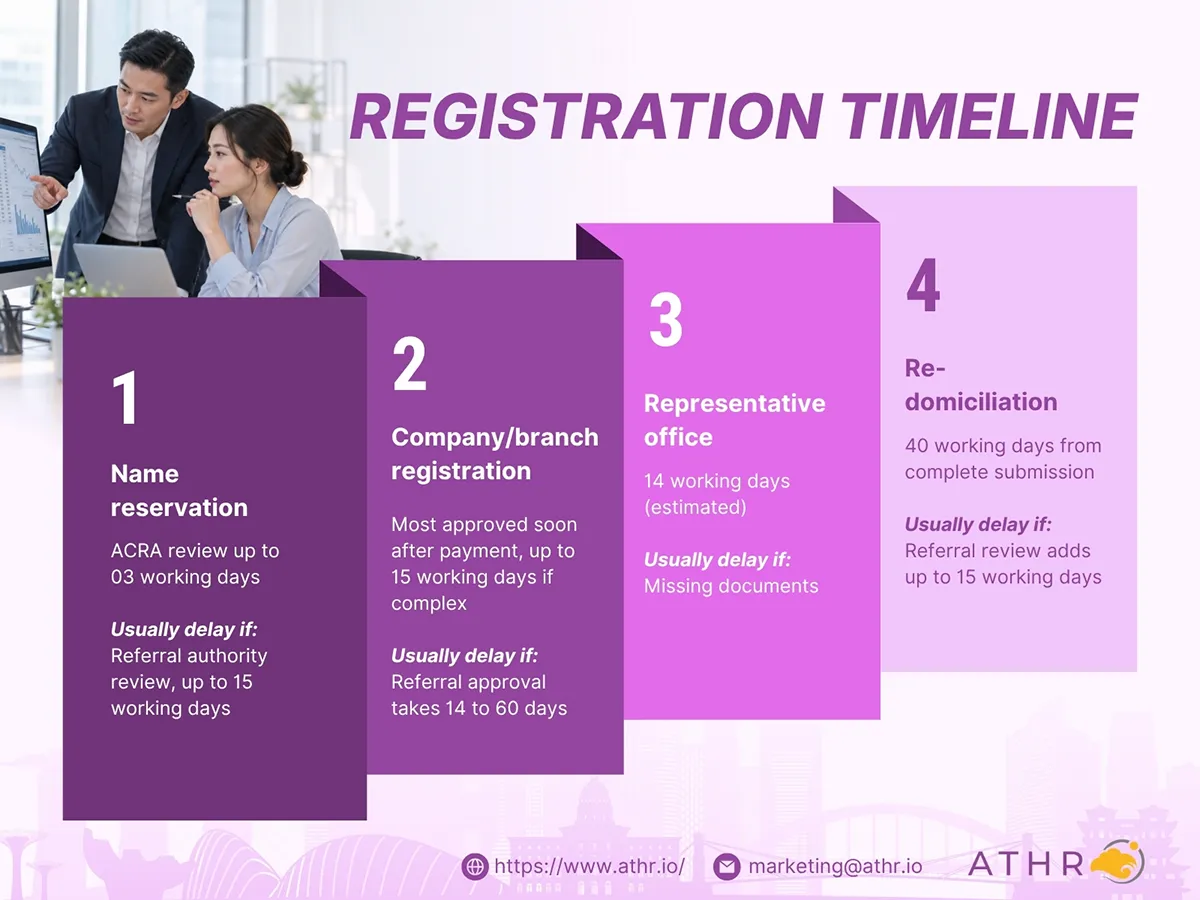
Timelines depend on the route and on whether a referral authority must approve the application.
Stage
Typical time
What can slow it
Name reservation
ACRA review up to three working days
Referral authority review, up to 15 working days
Company or branch registration
Most approved soon after payment, up to 15 working days if complex
Referral approval takes 14 to 60 days
Representative office
14 working days (estimated)
Missing documents
Re-domiciliation
40 working days from complete submission
Referral review adds up to 15 working days
If your business activity needs a licence or referral, plan for the longer end of each range.
How Do You Run the Business After Registration?
Approval starts the compliance cycle, and the obligations differ between a local company and a branch.
Local Company
A local company files its annual return within seven months of its financial year end, or eight months if it keeps an overseas branch register, per ACRA's deadlines page. It also files Estimated Chargeable Income (ECI) and a tax return with IRAS, at the 17% corporate tax rate shown on IRAS. Part 2 of this series, on Singapore company compliance, covers each deadline and penalty, and ATHR's guide to choosing a financial year end helps you set the cycle.
Report changes to company details within 14 days, and remember that directors' duties apply fully to nominee directors.
Foreign Company Branch
ACRA's annual filing page for foreign companies requires financial statements for both the head office and the Singapore branch each year. An active branch files audited statements and a dormant branch files unaudited ones. Head office statements not in English need an English translation, and ACRA asks for director changes to be updated within 30 days.
Practitioner's Note:
The branch's own accounts are only half the filing. Because ACRA also expects the head office statements, the parent's accountants become part of the Singapore process. Agree early who sends them, under which accounting standard, and with what translation.
Tax, GST and Work Passes in Brief
ACRA says a business must register for GST if its taxable turnover exceeds S$1 million at the end of any calendar year. The same applies if it reasonably expects to exceed that amount in the next 12 months. If your home country also taxes the income, ATHR's guide to double taxation agreements explains relief.
If you plan to live in Singapore and work in the business, you need a pass. MOM says the EntrePass suits founders of venture-backed or innovative technology companies, and the holder must own at least 30% of the company. A new Employment Pass currently needs a qualifying salary of at least S$5,600 (S$6,200 in financial services) and a pass in the points-based COMPASS test. From 1 January 2027 those salaries rise to S$6,000 and S$6,600. ATHR's guide for foreign founders covers passes in more depth, and a separate guide on hiring staff and work passes follows this series.
Common Mistakes Foreign Founders Make
Choosing a branch when limited liability matters. A branch is part of the parent, so a Singapore dispute can reach the parent's assets. If you want those assets protected, register a local company.
Letting a representative office trade. Its licence allows market research and feasibility work only, with no direct or indirect revenue activity. Move to a branch or a company before you start selling.
Leaving the local resident until filing day. The filing needs the resident director's or authorised representative's details, and they must meet ACRA's residency rules. ATHR's guide to why ACRA rejects incorporations covers other common causes.
Treating a nominee, authorised representative or CSP as removing your duties. Nominee directors carry the same legal duties as any director, and an authorised representative can be personally responsible. The provider files for you, but you stay accountable for what is filed.
Frequently Asked Questions About Registering a Company as a Foreigner
Can a foreigner own 100% of a Singapore company?
Yes. ACRA's shareholding guidance says a company can have individual and corporate shareholders, and sets no nationality condition. The residency requirement applies to a director, not the owners.
Do I need to live in Singapore to register a company?
No. You can register through a CSP while living overseas. The company still needs at least one director who meets ACRA's local residency rules, who can be a qualifying resident or a nominee director.
Is a corporate service provider mandatory for foreigners?
Yes. ACRA says foreigners must engage a CSP to reserve a name and register a business structure, and that all foreign businesses must engage one. The provider should be registered under the Corporate Service Providers Act.
Can a representative office earn revenue?
No. A representative office is limited to market research and feasibility studies, and it must not carry out revenue-generating activity for the parent. Its licence runs for a maximum of three years.
How much does it cost to register a company in Singapore as a foreigner?
The government fees are S$15 for the name and S$300 for registration, plus the provider's fee, which varies by scope. A representative office pays S$200 a year and re-domiciliation S$985.
Can I use a branch instead of setting up a company?
Yes, if the parent accepts full responsibility for the branch. A branch is not a separate entity and needs an authorised representative who meets local residency rules. A local company limits liability to its own assets.
Summary and Next Steps
Foreigners register through a CSP, and every route needs a locally resident person. The four routes trade limited liability against parent liability, and earning income against testing the market. Annual filings start in the first year.
Your next steps
Decide which of the four routes fits your situation, using the decision table.
Identify who will be your resident director or authorised representative.
Confirm that your CSP is registered and agree its scope in writing.
Gather the documents for your route, with certified copies and translations where needed.
Plan the first-year compliance calendar before you file.
Part 1 of this series, How to Register a Company in Singapore, covers the basic Pte. Ltd. steps, and part 2 covers company compliance after registration.
How ATHR Can Help
Start by telling us where you live, who will own the business, what it will do and which route you are considering. That tells us whether you need a resident director, an authorised representative or a licence, and which documents to prepare first.
ATHR prepares and files company incorporations for local and foreign founders, and offers a corporate secretary, nominee director arrangements, a registered address through its virtual office, accounting and tax. A dedicated key account manager and the ATHR platform track deadlines, so a missing document is caught before a filing date.
The ATHR Content Team is a group of professional writers from Singapore and the Philippines, committed to delivering informative, practical, and engaging content for business owners across Southeast Asia.
Free yourself from routine business tasks and let ATHR take the weight of financial administration off your shoulders. Smart solutions, seamless service, zero hassle.