Bringing a corporate investor into your Singapore company can provide funding and support for growth. It can also change your company’s compliance requirements.
An exempt private company in Singapore, or EPC, is already a private company. When a corporation acquires a beneficial interest in its shares, it generally stops qualifying as an EPC.
However, losing EPC status does not automatically mean an audit becomes compulsory or start-up tax exemption ends. Each requirement has its own conditions.
This guide explains what changes, what needs a separate review and how to prepare before completing the investment.
Key Takeaways
An ordinary EPC has no more than 20 members and no direct or indirect corporate beneficial interest in its shares.
A minority corporate investment can be enough to remove EPC eligibility.
Financial statement filing, audit exemption and tax exemption require separate assessments.
Review the ownership structure, transaction documents and reporting requirements before completing the investment.
Exempt Private Company vs Private Company: Key Differences
The comparison below covers an ordinary EPC limited by shares and a private company limited by shares that does not qualify as an EPC.
Area
Exempt private company
Non-EPC private company
Membership limit
Generally up to 20
Generally up to 50
Corporate beneficial ownership
Not permitted
Permitted
Limited liability
Yes
Yes
Financial statement filing
Exemption available if solvent
Generally required unless another exemption applies
Audit exemption
Subject to separate conditions
Can still qualify
Start-up tax exemption
Subject to IRAS conditions
Can still qualify
ACRA’s comparison of company types explains the ownership categories. Both structures remain private limited companies.
What Is an Exempt Private Company in Singapore?
An EPC is a private company that meets additional ownership conditions under the Companies Act.
For an ordinary privately owned company, these are:
No more than 20 members.
No corporation holding a beneficial interest in its shares, directly or indirectly.
A beneficial interest concerns the underlying ownership benefit. The person named as the shareholder may be holding shares for someone else.
For example, recording an individual as a nominee shareholder for a corporation does not avoid the corporate ownership restriction. The Companies Act’s EPC definition expressly includes indirect corporate interests.
The word “exempt” also does not remove general company responsibilities. Directors must still meet their duties, and the company must maintain proper records and comply with applicable tax requirements. The Singapore Companies Act guide explains these wider obligations.
What Changes When a Corporate Investor Joins?
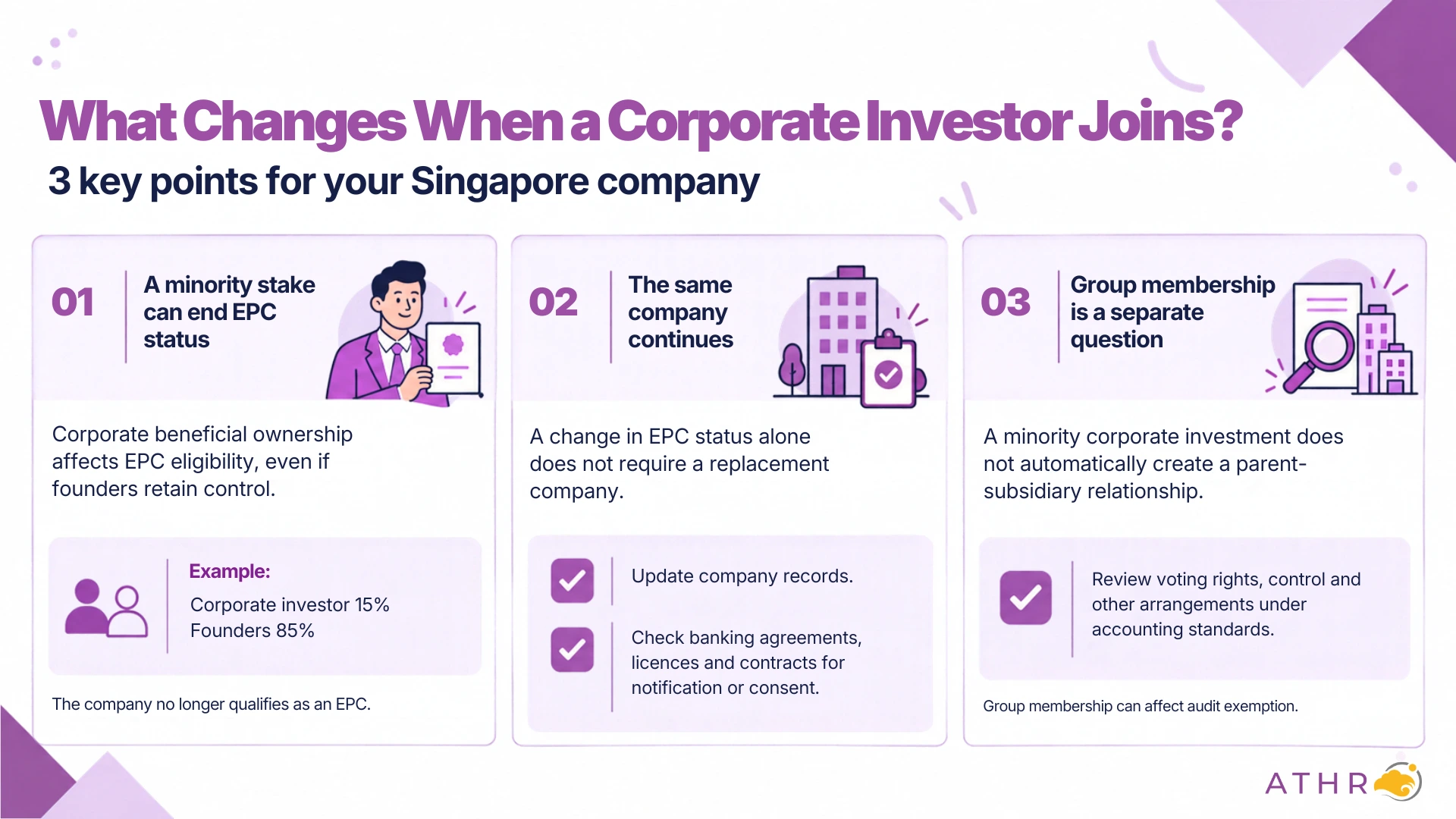
A corporate investor acquiring a beneficial interest in shares affects EPC eligibility, even if the founders retain control. The existing company continues, but its reporting and compliance position needs review.
A minority investment can remove EPC status
Imagine two founders personally own a Singapore software company. A corporate investor acquires 15% of its shares.
The founders still own 85%, but the company now has corporate beneficial ownership. The EPC restriction does not depend on the investor holding a majority.
The same issue arises when a founder transfers personally held shares to their own holding company.
The company does not need to start again
A straightforward share investment does not require a replacement company solely because EPC status changes.
Instead, prepare the share transaction and update the relevant company records. Separately check whether existing banking agreements, licences or contracts require notification or consent.
Corporate ownership and group membership are different
A minority corporate investment does not automatically create a parent-and-subsidiary relationship.
That assessment can depend on voting rights, control and other arrangements under the applicable accounting standards. It matters because group membership can affect the audit exemption assessment.
Will the Company Need to File Financial Statements?
A company that loses the solvent EPC filing exemption generally needs to file financial statements with ACRA unless another exemption applies.
A solvent company can pay its debts when they become due. A solvent EPC can qualify for exemption from filing financial statements, although it generally still needs to prepare them.
These are three separate tasks:
Task
What it means
Preparing financial statements
Producing the company’s accounts
Filing financial statements
Submitting them to ACRA
Auditing financial statements
Having an independent auditor examine them
ACRA’s financial statement filing requirements determine the relevant format. This may involve XBRL, a structured digital format for financial information. Filed statements are available for public purchase.
Practical note: Give your accountant the ownership timeline, completion documents and financial year-end. Ask which reporting period is affected and what needs to be filed.
Does Losing EPC Status Make an Audit Compulsory?
No. A company with corporate shareholders can still qualify for audit exemption.
Under ACRA’s small-company framework, a private company generally assesses whether it meets at least two of these criteria over the immediately preceding two consecutive financial years:
Measure
Threshold
Annual revenue
S$10 million or less
Total assets
S$10 million or less
Full-time employees at financial year-end
50 or fewer
Special rules apply to newly incorporated companies and to retaining or losing qualifying status. Exceeding one threshold alone does not automatically require an audit.
If the company belongs to a group, both the company and the group must meet the applicable conditions. The group assessment includes foreign entities.
Also ask what the investor expects. It may request audited accounts or additional reports as a contractual condition, even where statutory audit exemption remains available.
The Singapore audit exemption guide explains this assessment in more detail.
Will Corporate Investment Affect Start-Up Tax Exemption?
Corporate investment does not automatically end start-up tax exemption, commonly called SUTE. The Inland Revenue Authority of Singapore, or IRAS, applies separate eligibility conditions.
The company must be incorporated in Singapore and tax resident there for the relevant Year of Assessment, or YA.
Throughout the relevant basis period, its share capital must be beneficially held directly by no more than 20 shareholders. Either:
All shareholders are individuals; or
At least one individual holds 10% or more of the company’s issued ordinary shares.
SUTE applies only within the first three consecutive YAs, subject to eligibility. Investment-holding companies and companies undertaking property development for sale, investment or both are excluded. See IRAS’s start-up tax exemption conditions.
For example, a founder retaining 20% directly presents a different shareholding position from one retaining only 5%, with a corporation holding the balance.
Check the full relevant period and any planned dilution. The explanation of SUTE shareholder conditions provides further context.
What Else Should You Review?
Beyond filing and tax, check how the investment affects company funds, decision-making and everyday reporting.
Director loans and guarantees
Losing EPC eligibility can affect the rules governing loans, guarantees and certain transactions involving directors or connected persons.
Review proposed transactions and changes to existing arrangements under sections 162 and 163 of the Companies Act. Do not assume a previous arrangement remains available on the same terms.
Investor approval and reporting rights
An investor may request a board seat, monthly financial reports or approval rights over major decisions.
Agree on these requirements before signing. Clarify who prepares the reports, when they are due and which actions need investor consent.
GST obligations
Losing EPC status does not itself trigger Goods and Services Tax registration. Apply IRAS’s GST registration rules separately.
Do not automatically treat investment funds as customer sales. Share capital, loans and payments for goods or services require different accounting treatment.
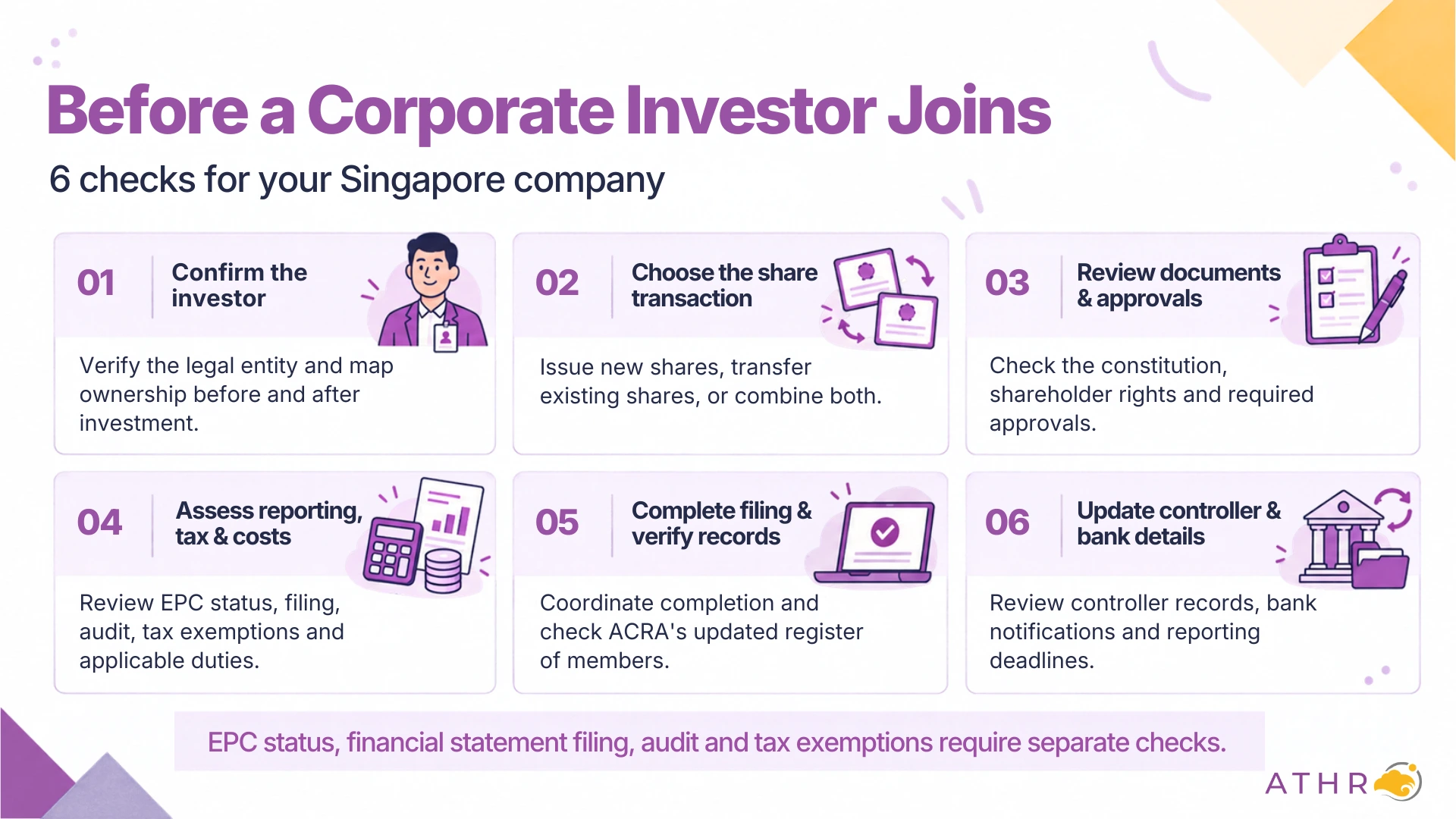
Checklist: Before a Corporate Investor Joins
Prepare the compliance work alongside the commercial negotiations. Assign an owner to each task so nothing is left until the next annual filing.
1. Confirm the investor and ownership structure
Obtain the investor’s legal name, registration details, ownership information and authorised signatory details.
Prepare a before-and-after ownership table showing share numbers, classes and percentages. Use the actual investing entity, which may differ from the investor’s trading name.
2. Decide how the investor will acquire shares
Transaction
What happens
Who receives the money?
New share allotment
The company issues additional shares
The company
Existing share transfer
A shareholder sells existing shares
The selling shareholder
A deal can include both. Confirm the structure before preparing the documents.
3. Check documents and approvals
Review the constitution, the company’s internal rulebook, and any shareholders’ agreement.
Identify transfer restrictions, existing shareholder rights and required approvals. ACRA’s share transfer guidance explains the filing requirements and supporting documents.
Record the conclusions on EPC eligibility, financial statement filing, audit exemption and SUTE.
For transfers, share duty is generally 0.2% of the purchase price or share value, whichever is higher. Special considerations can apply, including for certain property-holding entities. Check IRAS’s share acquisition rules against the transaction.
Budget for professional work and ongoing reporting as well as applicable duties.
5. Complete the filing and verify the records
For private companies, share allotments and transfers take effect when ACRA updates the Electronic Register of Members, or EROM.
Practical note: Coordinate signing, payment and filing. Do not automatically treat the agreement’s signing date as the effective shareholding change date.
6. Review controller and bank information
Assess whether the investment changes the company’s registrable controllers: individuals or entities with significant ownership or control.
Where required, update the private controller register and corresponding central filing. ACRA requires central RORC filing within two business days after the private register is updated. Follow its controller-register guidance.
Check bank notifications, authorised signatories and the reporting calendar too.
Frequently Asked Questions about EPCs
Can a foreign individual own an EPC?
Yes. The ordinary EPC definition does not restrict shareholders by nationality. However, investing personally differs from investing through a foreign company.
Does investing through my own holding company affect EPC status?
Yes, where that company acquires a beneficial interest in the shares. Your personal ownership of the holding company does not turn its investment into direct individual ownership.
Can an EPC have more than 20 individual shareholders?
An ordinary EPC cannot exceed the statutory membership limit. Ask the company secretary to check the applicable counting rules where joint holdings or employee-related arrangements are involved.
Does a corporate investor’s loan remove EPC status?
A conventional loan giving the lender no beneficial interest in shares does not, by itself, breach the corporate ownership condition. Convertible instruments need closer review because their terms or later conversion can affect eligibility.
Can a company regain EPC status?
It can qualify again if it meets the EPC definition after the corporate shareholder exits. Review membership and beneficial ownership, along with the requirements for each reporting period.
Does losing EPC status increase the corporate tax rate?
No. Singapore’s prevailing corporate income tax rate is 17%; EPCs do not have a separate headline rate. The amount payable can still change if the company’s eligibility for exemptions changes.
How ATHR Can Help You Prepare for Corporate Investment
Before completing the investment, gather your ownership records, proposed shareholding structure, latest accounts and financial year-end. These help identify the documents, filings and reporting work required.
Contact ATHR to discuss your proposed investment. Share who is investing, how the shares will be acquired and your expected completion date so the team can explain the next steps and service scope.
Disclaimer
This guide provides general information based on Singapore legislation and regulatory guidance available as of October 2026. It is not legal, tax, accounting or investment advice. Requirements depend on your company’s circumstances and may change. Obtain advice on your ownership structure, transaction and reporting periods before acting.
Exempt Private Company vs Private Company: Key Differences
The comparison below covers an ordinary EPC limited by shares and a private company limited by shares that does not qualify as an EPC.
Area
Exempt private company
Non-EPC private company
Membership limit
Generally up to 20
Generally up to 50
Corporate beneficial ownership
Not permitted
Permitted
Limited liability
Yes
Yes
Financial statement filing
Exemption available if solvent
Generally required unless another exemption applies
Audit exemption
Subject to separate conditions
Can still qualify
Start-up tax exemption
Subject to IRAS conditions
Can still qualify
ACRA’s comparison of company types explains the ownership categories. Both structures remain private limited companies.
What Is an Exempt Private Company in Singapore?
An EPC is a private company that meets additional ownership conditions under the Companies Act.
For an ordinary privately owned company, these are:
No more than 20 members.
No corporation holding a beneficial interest in its shares, directly or indirectly.
A beneficial interest concerns the underlying ownership benefit. The person named as the shareholder may be holding shares for someone else.
For example, recording an individual as a nominee shareholder for a corporation does not avoid the corporate ownership restriction. The Companies Act’s EPC definition expressly includes indirect corporate interests.
The word “exempt” also does not remove general company responsibilities. Directors must still meet their duties, and the company must maintain proper records and comply with applicable tax requirements. The Singapore Companies Act guide explains these wider obligations.
What Changes When a Corporate Investor Joins?
A corporate investor acquiring a beneficial interest in shares affects EPC eligibility, even if the founders retain control. The existing company continues, but its reporting and compliance position needs review.
A minority investment can remove EPC status
Imagine two founders personally own a Singapore software company. A corporate investor acquires 15% of its shares.
The founders still own 85%, but the company now has corporate beneficial ownership. The EPC restriction does not depend on the investor holding a majority.
The same issue arises when a founder transfers personally held shares to their own holding company.
The company does not need to start again
A straightforward share investment does not require a replacement company solely because EPC status changes.
Instead, prepare the share transaction and update the relevant company records. Separately check whether existing banking agreements, licences or contracts require notification or consent.
Corporate ownership and group membership are different
A minority corporate investment does not automatically create a parent-and-subsidiary relationship.
That assessment can depend on voting rights, control and other arrangements under the applicable accounting standards. It matters because group membership can affect the audit exemption assessment.
Will the Company Need to File Financial Statements?
A company that loses the solvent EPC filing exemption generally needs to file financial statements with ACRA unless another exemption applies.
A solvent company can pay its debts when they become due. A solvent EPC can qualify for exemption from filing financial statements, although it generally still needs to prepare them.
These are three separate tasks:
Task
What it means
Preparing financial statements
Producing the company’s accounts
Filing financial statements
Submitting them to ACRA
Auditing financial statements
Having an independent auditor examine them
ACRA’s financial statement filing requirements determine the relevant format. This may involve XBRL, a structured digital format for financial information. Filed statements are available for public purchase.
Practical note: Give your accountant the ownership timeline, completion documents and financial year-end. Ask which reporting period is affected and what needs to be filed.
Does Losing EPC Status Make an Audit Compulsory?
No. A company with corporate shareholders can still qualify for audit exemption.
Under ACRA’s small-company framework, a private company generally assesses whether it meets at least two of these criteria over the immediately preceding two consecutive financial years:
Measure
Threshold
Annual revenue
S$10 million or less
Total assets
S$10 million or less
Full-time employees at financial year-end
50 or fewer
Special rules apply to newly incorporated companies and to retaining or losing qualifying status. Exceeding one threshold alone does not automatically require an audit.
If the company belongs to a group, both the company and the group must meet the applicable conditions. The group assessment includes foreign entities.
Also ask what the investor expects. It may request audited accounts or additional reports as a contractual condition, even where statutory audit exemption remains available.
The Singapore audit exemption guide explains this assessment in more detail.
Will Corporate Investment Affect Start-Up Tax Exemption?
Corporate investment does not automatically end start-up tax exemption, commonly called SUTE. The Inland Revenue Authority of Singapore, or IRAS, applies separate eligibility conditions.
The company must be incorporated in Singapore and tax resident there for the relevant Year of Assessment, or YA.
Throughout the relevant basis period, its share capital must be beneficially held directly by no more than 20 shareholders. Either:
All shareholders are individuals; or
At least one individual holds 10% or more of the company’s issued ordinary shares.
SUTE applies only within the first three consecutive YAs, subject to eligibility. Investment-holding companies and companies undertaking property development for sale, investment or both are excluded. See IRAS’s start-up tax exemption conditions.
For example, a founder retaining 20% directly presents a different shareholding position from one retaining only 5%, with a corporation holding the balance.
Check the full relevant period and any planned dilution. The explanation of SUTE shareholder conditions provides further context.
What Else Should You Review?
Beyond filing and tax, check how the investment affects company funds, decision-making and everyday reporting.
Director loans and guarantees
Losing EPC eligibility can affect the rules governing loans, guarantees and certain transactions involving directors or connected persons.
Review proposed transactions and changes to existing arrangements under sections 162 and 163 of the Companies Act. Do not assume a previous arrangement remains available on the same terms.
Investor approval and reporting rights
An investor may request a board seat, monthly financial reports or approval rights over major decisions.
Agree on these requirements before signing. Clarify who prepares the reports, when they are due and which actions need investor consent.
GST obligations
Losing EPC status does not itself trigger Goods and Services Tax registration. Apply IRAS’s GST registration rules separately.
Do not automatically treat investment funds as customer sales. Share capital, loans and payments for goods or services require different accounting treatment.
Checklist: Before a Corporate Investor Joins
Prepare the compliance work alongside the commercial negotiations. Assign an owner to each task so nothing is left until the next annual filing.
1. Confirm the investor and ownership structure
Obtain the investor’s legal name, registration details, ownership information and authorised signatory details.
Prepare a before-and-after ownership table showing share numbers, classes and percentages. Use the actual investing entity, which may differ from the investor’s trading name.
2. Decide how the investor will acquire shares
Transaction
What happens
Who receives the money?
New share allotment
The company issues additional shares
The company
Existing share transfer
A shareholder sells existing shares
The selling shareholder
A deal can include both. Confirm the structure before preparing the documents.
3. Check documents and approvals
Review the constitution, the company’s internal rulebook, and any shareholders’ agreement.
Identify transfer restrictions, existing shareholder rights and required approvals. ACRA’s share transfer guidance explains the filing requirements and supporting documents.
Record the conclusions on EPC eligibility, financial statement filing, audit exemption and SUTE.
For transfers, share duty is generally 0.2% of the purchase price or share value, whichever is higher. Special considerations can apply, including for certain property-holding entities. Check IRAS’s share acquisition rules against the transaction.
Budget for professional work and ongoing reporting as well as applicable duties.
5. Complete the filing and verify the records
For private companies, share allotments and transfers take effect when ACRA updates the Electronic Register of Members, or EROM.
Practical note: Coordinate signing, payment and filing. Do not automatically treat the agreement’s signing date as the effective shareholding change date.
6. Review controller and bank information
Assess whether the investment changes the company’s registrable controllers: individuals or entities with significant ownership or control.
Where required, update the private controller register and corresponding central filing. ACRA requires central RORC filing within two business days after the private register is updated. Follow its controller-register guidance.
Check bank notifications, authorised signatories and the reporting calendar too.
Frequently Asked Questions about EPCs
Can a foreign individual own an EPC?
Yes. The ordinary EPC definition does not restrict shareholders by nationality. However, investing personally differs from investing through a foreign company.
Does investing through my own holding company affect EPC status?
Yes, where that company acquires a beneficial interest in the shares. Your personal ownership of the holding company does not turn its investment into direct individual ownership.
Can an EPC have more than 20 individual shareholders?
An ordinary EPC cannot exceed the statutory membership limit. Ask the company secretary to check the applicable counting rules where joint holdings or employee-related arrangements are involved.
Does a corporate investor’s loan remove EPC status?
A conventional loan giving the lender no beneficial interest in shares does not, by itself, breach the corporate ownership condition. Convertible instruments need closer review because their terms or later conversion can affect eligibility.
Can a company regain EPC status?
It can qualify again if it meets the EPC definition after the corporate shareholder exits. Review membership and beneficial ownership, along with the requirements for each reporting period.
Does losing EPC status increase the corporate tax rate?
No. Singapore’s prevailing corporate income tax rate is 17%; EPCs do not have a separate headline rate. The amount payable can still change if the company’s eligibility for exemptions changes.
How ATHR Can Help You Prepare for Corporate Investment
Before completing the investment, gather your ownership records, proposed shareholding structure, latest accounts and financial year-end. These help identify the documents, filings and reporting work required.
Contact ATHR to discuss your proposed investment. Share who is investing, how the shares will be acquired and your expected completion date so the team can explain the next steps and service scope.
Disclaimer
This guide provides general information based on Singapore legislation and regulatory guidance available as of October 2026. It is not legal, tax, accounting or investment advice. Requirements depend on your company’s circumstances and may change. Obtain advice on your ownership structure, transaction and reporting periods before acting.
ATHR Content Team
ATHR Articles & Guides
The ATHR Content Team is a group of professional writers from Singapore and the Philippines, committed to delivering informative, practical, and engaging content for business owners across Southeast Asia.
Free yourself from routine business tasks and let ATHR take the weight of financial administration off your shoulders. Smart solutions, seamless service, zero hassle.