Your company is registered. Does it still have to file anything if it has no customers yet? Who tells you when a deadline is coming? And what happens if you miss one?
Singapore company compliance is the set of yearly filings, tax returns and record-keeping duties that every registered company must meet, whether or not it earns revenue. Two agencies set the rules; the Accounting and Corporate Regulatory Authority (ACRA) registers and regulates companies while the Inland Revenue Authority of Singapore serves as the country’s tax authority (IRAS).
This guide is part two of ATHR's series for new founders. Part one showed how to register a company. This guide covers what comes next: the compliance calendar, tax filings, company records, 2026 rule changes and penalties. It is written for first-time founders and for foreign founders who run a Singapore company from abroad.
Key Takeaways
A private company must hold its annual general meeting (AGM) within 6 months of its financial year end, unless exempt, and file its annual return within 7 months.
A late annual return costs S$300 within 3 months and S$600 after that. Repeated breaches can lead to prosecution, director disqualification or striking off.
Tax runs on a separate clock: Estimated Chargeable Income (ECI) is due within 3 months of year end, and the tax return (Form C-S) by 30 November.
Changes to directors, secretaries, addresses and shareholders must reach ACRA within 14 days.
Singapore Company Compliance at a Glance
The table summarises the facts most new founders need first.
Item
Details
Who needs this
Every Singapore-registered company, including dormant and no-revenue companies
ACRA annual return fee
S$60 (ACRA fee schedule, updated 29 January 2026)
Main deadlines
Counted from your financial year end: ECI at 3 months, AGM at 6, annual return at 7. Tax return on 30 November
Biggest delay risk
Accounts and records not ready in time
Who is responsible
The directors. A secretary, accountant or filing agent often does the work
Which Obligations Apply to Your Company?
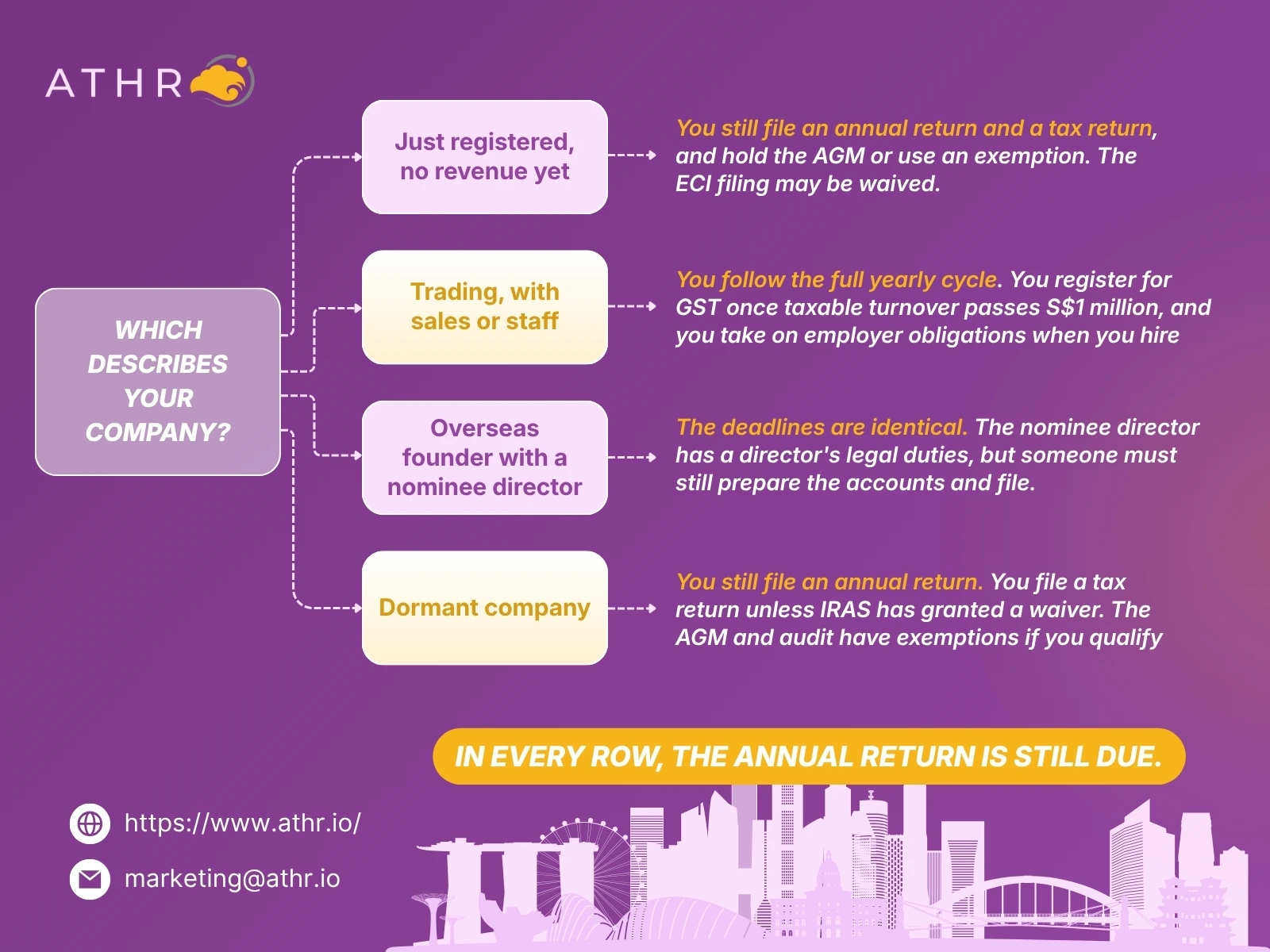
Nearly every obligation in this guide applies to every Singapore company, whether or not it earns revenue. The amount of work changes with what your company does, but even a dormant company still files an annual return with ACRA.
The table shows where most new founders sit.
Your situation
What this means for you
Just registered, no revenue yet
You still file an annual return and a tax return, and hold the AGM or use an exemption. The ECI filing may be waived
Trading, with sales or staff
You follow the full yearly cycle. You register for GST once taxable turnover passes S$1 million, and you take on employer obligations when you hire
Overseas founder with a nominee director
The deadlines are identical. The nominee director has a director's legal duties, but someone must still prepare the accounts and file
Dormant company
You still file an annual return. You file a tax return unless IRAS has granted a waiver. The AGM and audit have exemptions if you qualify
Imagine Maria, a founder in Manila, who registers a company in March 2026 with a 31 December year end and makes no sales in year one. Her first financial year ends on 31 December 2026. She still files the annual return by 31 July 2027 and the tax return by 30 November 2027.
What Is Company Compliance in Singapore?
Company compliance in Singapore means meeting the recurring filing, tax and record-keeping duties the law places on every registered company and its directors. ACRA handles corporate filings such as the annual return. IRAS handles tax. Both agencies count their deadlines from your financial year end.
Your financial year end (FYE) is the last day of your company's accounting year. You chose it when you registered, and it sets almost every deadline in this guide. Part one explains how to choose it.
You file with ACRA through Bizfile+, ACRA's online portal. Corppass is the digital login a company uses to deal with government agencies. Directors stay responsible even when someone else files for them, and ACRA's guidance on directors' duties applies to all directors, including nominee directors.
Your Compliance Calendar: First 12 Months and Every Year After
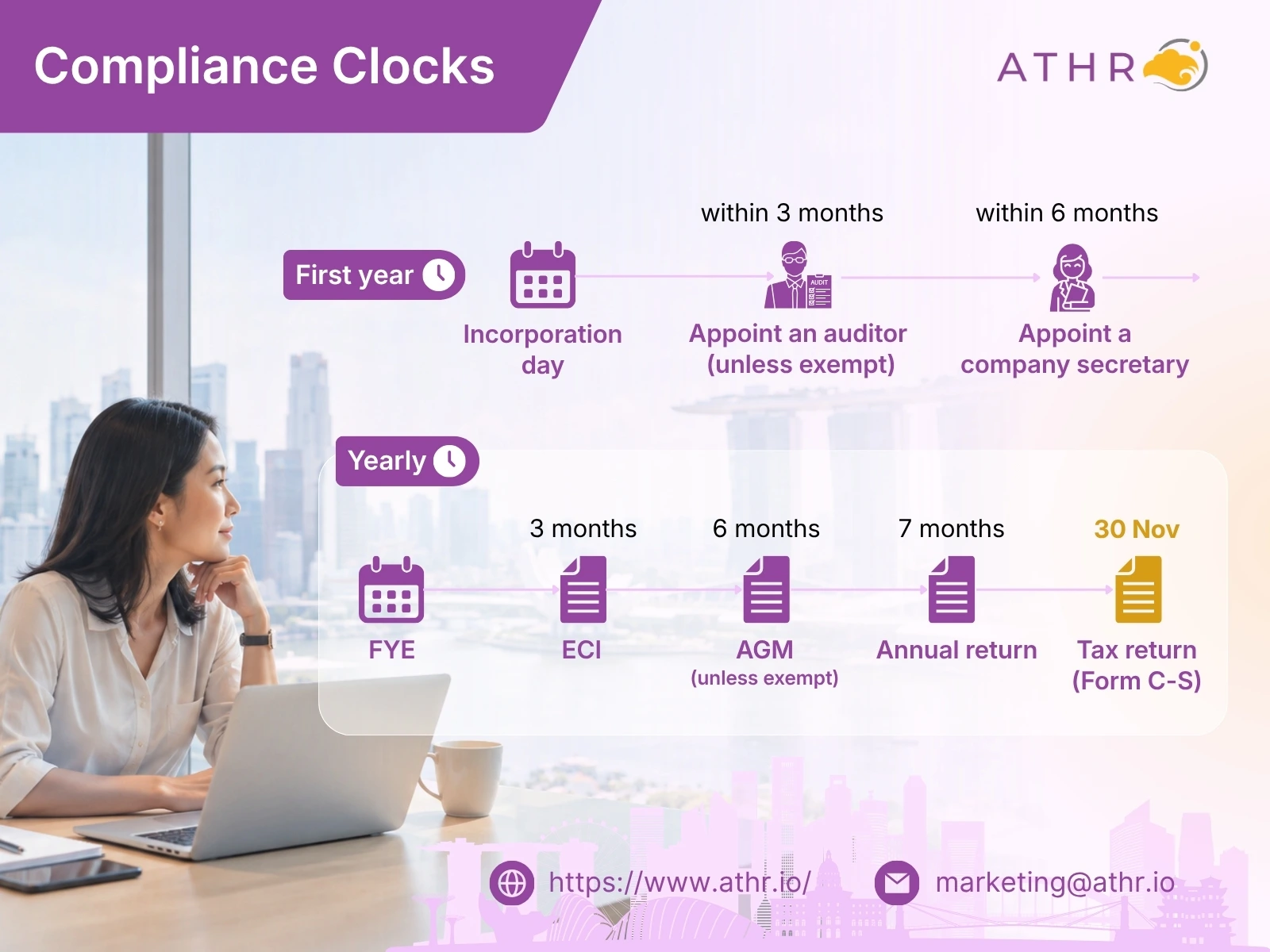
Your company runs on two clocks. The first starts on your incorporation date and covers one-off appointments. The second starts on your financial year end and repeats every year.
The first-year clock
The table lists what falls due in your first year, in order.
When
What you must do
Within 3 months of incorporation
Appoint an auditor, unless your company qualifies for the audit exemption
Within 6 months of incorporation
Appoint a company secretary. The same person cannot be both the sole director and the secretary
Within 14 days of any change
Tell ACRA about changes to officers, addresses or shareholders
After your first year closes, four deadlines repeat. As of October 2026, a company with a 31 December 2025 year end has one left this year: the tax return on 30 November.
Your financial year end is harder to change than it looks. ACRA does not allow a change after you have missed the AGM, annual return or financial statement deadlines. It also needs ACRA's approval if the new period runs beyond 18 months or you changed your year end in the past five years.
Treat the date you chose at registration as fixed.
What Must You File With ACRA Every Year?
Every company files an annual return with ACRA each year. Most also hold an AGM and file financial statements, and many small companies are exempt from an audit. ACRA's requirements follow a set order: prepare accounts, hold the AGM, file the annual return and file the financial statements.
Do You Have to Hold an AGM?
Yes, unless an exemption applies. A private company must hold its AGM within 6 months after its financial year end. It can skip the AGM in three cases: sending financial statements to all members within 5 months of year end, being dormant with total assets of S$500,000 or less, or all members agreeing to dispense with AGMs.
ACRA's AGM page lists these routes and allows you to apply for an extension before the deadline. ATHR's AGM guide explains each in practice.
Practitioner's Note:
An exemption does not remove the paperwork. When you file your annual return, ACRA requires you to declare your AGM status: held, exempt or dispensed with.
Decide which route you are using before you open the filing.
The Annual Return
All companies registered in Singapore must file an annual return each year, even if inactive or dormant. The deadline is 7 months after year end, or 8 months if the company keeps a branch register outside Singapore. The fee is S$60, and an extension of time costs S$200.
The annual return does not replace your tax filing with IRAS, as ACRA's deadline page confirms.
Financial Statements and XBRL
Most companies must file their financial statements with ACRA in XBRL format, with limited exceptions. XBRL is a digital tagging format that lets ACRA read each figure automatically, and your accountant normally prepares it.
Plain-English: XBRL means your accounts are submitted as structured data, not only as a PDF.
ACRA's rules vary by company type. Smaller companies, with revenue and total assets both at S$500,000 or less, file a simplified version plus a PDF. Qualifying dormant companies are exempt. Solvent exempt private companies may choose whether to file. ATHR's XBRL guide covers software and common errors.
Does Your Company Need an Audit?
Not always. A private company is exempt from audit if it meets at least 2 of 3 thresholds for two consecutive financial years: revenue of S$10 million or less, total assets of S$10 million or less, and 50 or fewer full-time employees. A company under two years old needs to meet them only in its current year.
Companies in a group must also meet the thresholds as a group. Imagine a software company with S$400,000 in revenue, S$150,000 in assets and four employees. It needs no audit, but it still prepares and files financial statements.
IRAS needs two things from most companies each year: an estimate of taxable profit, called ECI, within 3 months of year end, and the tax return by 30 November. Both are separate from your ACRA filings, and a company that is behind on one can be on time on the other.
What Is ECI and When Is It Due?
Estimated Chargeable Income (ECI) is your company's estimate of its taxable profit for the financial year. Companies must file it within 3 months of their financial year end. You do not need to file it if annual revenue is S$5 million or below and your ECI is nil.
Most small companies file Form C-S or Form C-S (Lite). IRAS sets these thresholds:
Form C-S: companies with annual revenue of S$5 million or below.
Form C-S (Lite): companies with annual revenue of S$200,000 or below, who may choose Form C-S or Form C instead.
Form C: the full return for companies that do not qualify for the simpler forms.
The simplified forms are for Singapore-incorporated companies with only standard-rate income and no claims for certain reliefs. IRAS gives the corporate income tax rate as 17%. Rebates and exemptions change by year, so check IRAS's current list before assuming one applies.
Watch out: The ECI waiver only removes the ECI filing. The tax return is still due on 30 November.
When Must You Register for GST?
You must register for Goods and Services Tax (GST) once your taxable turnover exceeds S$1 million. IRAS assesses this over each calendar year, and you must apply within 30 days of the year end. If you register late, your liability is backdated to the date you should have registered.
You owe GST on that period even if you never charged it to customers, as IRAS explains.
Keeping Records and Company Details Up to Date
Part one covered how to set up your records. This section covers keeping them accurate between filings.
The 14-Day Rule
You must tell ACRA about changes within 14 days through Bizfile+. This covers company details such as your name and registered office address, officer details such as appointments and address changes, and share and shareholder changes. ACRA's page on updating company information states that late notifications carry penalties.
Company Registers
Your company keeps registers of members, directors and secretaries, and a Register of Registrable Controllers (RORC), which records the people who own or control it. Nominee arrangements need their own registers. ACRA's page on company registers sets the update deadlines:
Members, directors and secretaries: update within 14 days of the change.
Registrable controllers (RORC): update within 7 days of the change.
Nominee directors and shareholders: update within 7 days of the change. For companies registered after 16 June 2025, also file the update with ACRA within 2 business days.
Keep accounting records for at least 5 years after each financial year ends. ATHR's guide to company registers explains what each holds.
Registered Office and Company Secretary
Your registered office must be a physical Singapore address, not a P.O. box, open to the public for at least three hours on each business day. ACRA states that non-compliance can lead to a fine of up to S$5,000. ACRA also sends its communications there.
Watch out: If you are an overseas founder, make sure someone checks the mail at your registered office and passes anything urgent to the directors.
Your company secretary maintains the registers, arranges meetings and reminds directors of filing deadlines. Appointing one within 6 months is a legal requirement, and ACRA states that directors can be fined up to S$1,000 if the company does not.
What Changed in 2026?
Several changes took effect on 6 May 2026 and raised the stakes for directors. Fines for director breaches rose to as much as S$20,000, and a money laundering conviction now disqualifies a person from acting as a director.
Higher penalties for directors: The maximum fine for director breaches rises from S$5,000 to S$20,000. Serious offences can also carry up to 12 months in prison.
Money laundering disqualification: A person convicted of a money laundering offence under the Corruption, Drug Trafficking and Other Serious Crimes (Confiscation of Benefits) Act 1992 cannot act as a director.
New Form 45 declarations: Before an appointment, the person declares no money laundering conviction and awareness of their statutory obligations. ACRA's Form 45 notice requires you to keep the completed form as a statutory record.
Other changes: Audit reports must name the public accountant primarily responsible, and selective share buy-backs need two 75% approvals.
For directors, a missed duty now carries a higher ceiling. ATHR's guide to the May 2026 ACRA changes covers the wider governance picture.
What Happens If You File Late or Miss a Requirement?
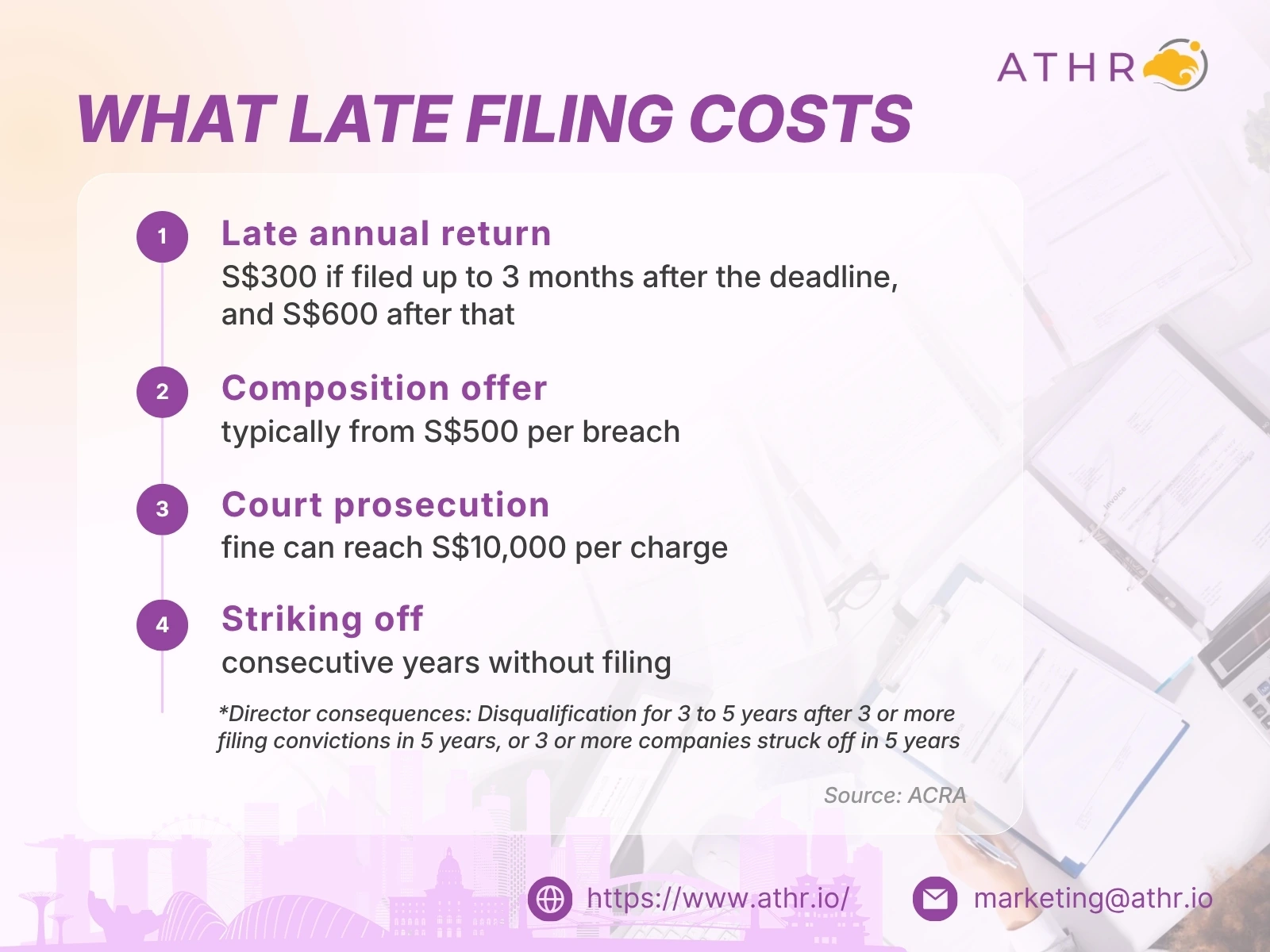
Late filing starts small and escalates for repeated or long-running breaches. A late annual return costs S$300 within 3 months and S$600 after that. ACRA can then offer a composition, prosecute, strike the company off or disqualify directors, and IRAS can issue its own assessment for a late tax return.
The main steps, in the order they usually escalate, are:
Late annual return: S$300 if filed up to 3 months after the deadline, and S$600 after that. ACRA applies it when you submit through Bizfile+.
Composition offer: ACRA may offer to settle without court, typically from S$500 per breach.
Court prosecution: If the composition is rejected or breaches repeat, ACRA may prosecute the company and its directors. The fine can reach S$10,000 per charge.
Striking off: Consecutive years without filing can lead ACRA to strike the company off the register, which ends its legal existence.
Director consequences: Disqualification for 3 to 5 years after 3 or more filing convictions in 5 years, or 3 or more companies struck off in 5 years. Directors can also be barred from new appointments after 3 or more months of continuous failure to lodge.
Late tax return: IRAS may issue a composition fee of up to S$5,000, summon directors to court, or estimate your income and issue its own assessment (IRAS guidance for YA 2025).
ACRA sets out these steps on its page on late annual return penalties, and its penalty announcement confirms the S$300 and S$600 amounts. Directors can appeal using ACRA's late lodgement appeal form, with reviews usually taking about four weeks.
Practitioner's Note:
The late fee is set the moment you submit, and it doubles at the three-month mark. Once a return is overdue, filing sooner is cheaper.
Do not wait for perfect accounts before submitting.
If a company has stopped trading, filing every year is not the only choice. ATHR's comparison of dormant status and striking off explains each.
Common Compliance Mistakes and How to Avoid Them
Assuming no revenue means no filings. Every registered company files an annual return, including inactive and dormant ones. Put the deadlines in your calendar on the day you register.
Treating the ECI waiver as a tax exemption. The waiver removes one filing, not the tax return. Read the wording carefully.
Missing the 14-day update. A new director, a changed address or a share transfer starts a 14-day clock, and late lodgement penalties apply after it. Ask whoever handles your filings to tell you when a change happens.
Leaving the accounts until the last month. The AGM is due at 6 months and the annual return at 7, and both need finished accounts. Missing receipts and unreconciled bank statements are the usual causes of delay.
Assuming a nominee director or filing agent carries your responsibility. ACRA's duties apply to all directors, including nominees. A filing agent submits documents but does not take over the legal duty to file on time.
Self-Filing, Filing Agent or Full-Service Provider?
You can manage ongoing compliance yourself, through a registered filing agent, or through a full-service provider. The right route depends on how much your company does, where your directors live and how much time you have to track deadlines.
The table compares the three routes.
Route
Best for
Watch out for
Self-filing through Bizfile+ and Corppass
A simple company with a director in Singapore and basic accounts
You carry every deadline and update yourself
Registered filing agent
Companies that want ACRA filings submitted correctly
Check whether accounts and tax are included, because filing and preparing accounts are different jobs
Full-service provider (secretary, accounting and tax)
Overseas founders, companies with staff or GST, and busy founders
Confirm the scope in writing: which filings and which deadlines
Self-filing is reasonable for a simple company, and the other routes earn their cost as the company grows. ATHR's explainer on ACRA filing agents covers how they differ from corporate service providers.
Frequently Asked Questions About Singapore Company Compliance
Do I have to file anything if my company has no revenue?
Yes. Every company registered in Singapore must file an annual return each year, even if inactive or dormant. You also file a tax return by 30 November unless IRAS has granted a waiver. The ECI filing may be waived if revenue is S$5 million or below and ECI is nil.
Do I have to hold an AGM?
Usually, but not always. A private company must hold its AGM within 6 months of year end. Three exemptions exist: sending financial statements to members within 5 months, being dormant with assets of S$500,000 or less, or all members agreeing to dispense with AGMs. You still declare your AGM status in the annual return.
What is the penalty for filing the annual return late?
S$300 if you file within 3 months of the deadline, and S$600 after that. ACRA applies it when you submit. Repeated breaches can lead to a composition offer, prosecution, striking off and director disqualification.
Does my company need an audit?
Not if it is a private company meeting at least 2 of 3 thresholds for two consecutive years. The thresholds are revenue of S$10 million or less, total assets of S$10 million or less and 50 or fewer employees. You must still file financial statements. Group companies must meet the thresholds as a group.
Do I need to file ECI if my company made a loss?
Not if annual revenue is S$5 million or below and your ECI is nil, because IRAS waives the filing. A loss typically gives a nil ECI, but confirm with your accountant. The waiver does not remove the tax return due on 30 November.
Can I change my financial year end?
Sometimes. You can change it for the current or previous financial year, but not after missing the AGM, annual return or financial statement deadlines. ACRA's approval is also needed if the new period exceeds 18 months or you changed your year end in the past five years.
Does a nominee director or filing agent take over my responsibilities?
No. A nominee director has a director's full legal duties, and a filing agent only submits what you give it. The company and its directors remain responsible for filing correctly and on time.
How ATHR Can Help
If you are not sure where your company stands, start by writing down a few details. Note your financial year end, who your directors are and where they live, whether you have revenue or staff, and what you have already filed. With those, it is straightforward to see which deadlines are close and what is missing.
ATHR's corporate secretary service supports the statutory filings and compliance tracking covered in this guide. When secretarial and accounting work sit with one team, a missing document comes up before the AGM and annual return deadlines, not after them. Share your year end, your directors' locations and your filing history, and the team can explain the next steps, the documents you need and the scope of support.
The ATHR Content Team is a group of professional writers from Singapore and the Philippines, committed to delivering informative, practical, and engaging content for business owners across Southeast Asia.
Free yourself from routine business tasks and let ATHR take the weight of financial administration off your shoulders. Smart solutions, seamless service, zero hassle.