Do you have to register as an employer before you hire? Is a written contract compulsory? And do the same rules apply to a Singapore citizen, a foreign pass holder and a freelancer?
Employer requirements in Singapore are the legal duties you take on when you hire an employee. They cover written terms, CPF, payslips, pay deadlines, working hours, leave and fair hiring. Most come from the Employment Act, which the Ministry of Manpower (MOM) administers, and from CPF Board rules.
This guide gives first-time employers the full map of those duties, ordered by when each one falls due. It is written for founders, including foreign founders hiring in Singapore for the first time. It focuses on what you must do, not on how a pay run is calculated.
Key Takeaways
Employer duties start before day one, because CPF Board advises applying for a CPF Submission Number as soon as you intend to hire.
Written Key Employment Terms are due within 14 days of the first day of work. A payslip is due with each payment or within 3 working days, and salary is due within 7 days after the salary period ends.
Which rules apply depends on who you hire: CPF covers Singapore citizens and permanent residents only, while the Employment Act protects employees of every nationality.
Work injury insurance is compulsory for all manual workers and for non-manual workers earning S$2,600 or less a month. The penalty is a fine of up to S$10,000, jail of up to 12 months, or both.
Employer Requirements in Singapore at a Glance
The table summarises the main duties as of October 2026, based on MOM and CPF Board pages.
Item
What to know
Who this applies to
Any Singapore company with at least one employee, whatever the employee's nationality
First steps
Get a CPF Submission Number, arrange work injury insurance if the role qualifies, prepare written terms
Key deadlines
Written terms within 14 days of the first day, salary within 7 days after the salary period, payslip with payment or within 3 working days
CPF
Due by the last day of the month, with interest of 1.5% a month on late payments
Biggest risk
Treating an employee as a contractor, or missing a duty because it never appeared on a checklist
Four Common Hires by Singaporean Companies
Which Employer Requirements Apply to Your Hire?
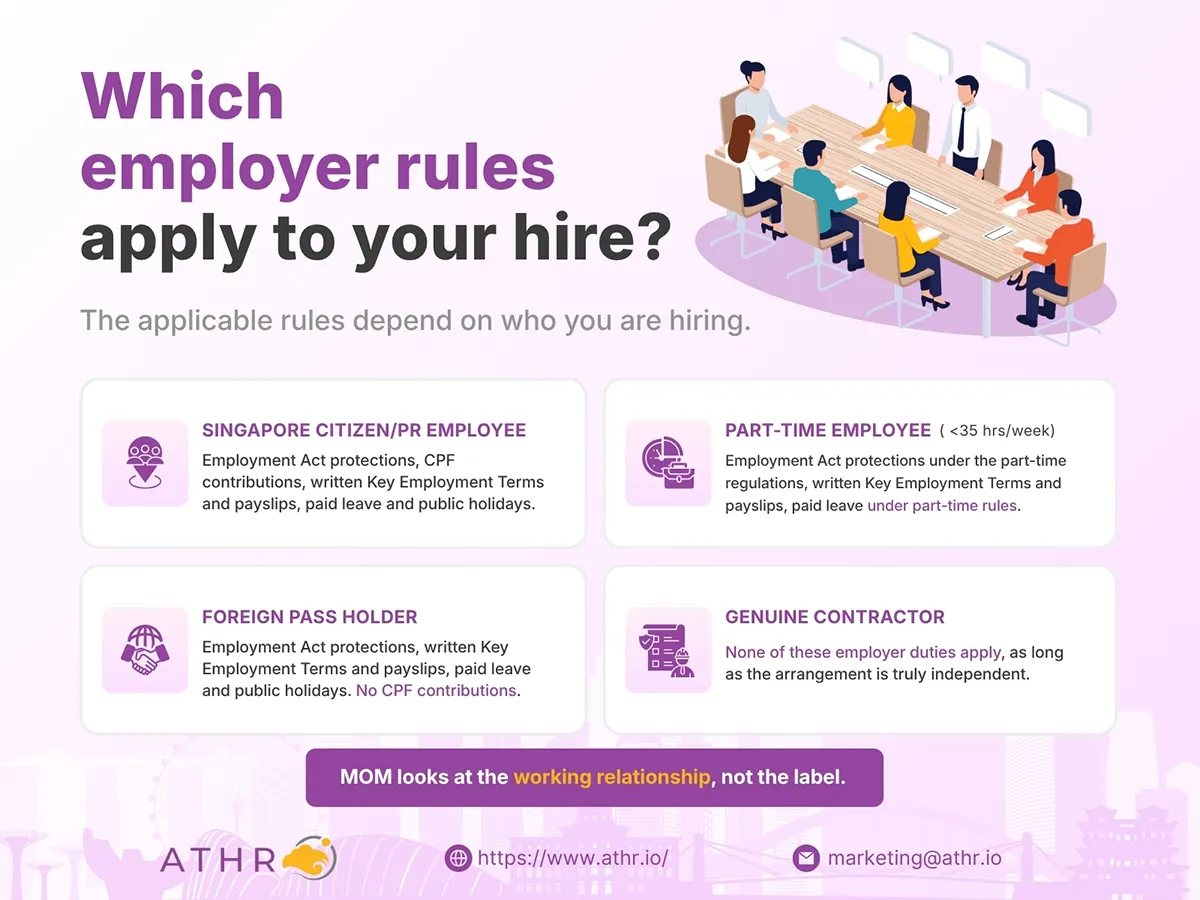
The rules depend on who you hire. The Employment Act protects employees of every nationality, CPF applies only to Singapore citizens and permanent residents (PRs), and a genuine contractor falls outside both.
The table shows how the main duties apply to four common hires.
Duty
Citizen or PR employee
Foreign pass holder
Part-time employee (under 35 hours a week)
Genuine contractor
Employment Act protections
Yes
Yes
Yes, under the part-time regulations
No
CPF contributions
Yes
No
Yes, if a citizen or PR
No
Written Key Employment Terms and payslips
Yes
Yes
Yes
No
Paid leave and public holidays
Yes
Yes
Yes, under part-time rules
No
Picture a founder who hires a marketing manager on an Employment Pass, a Singapore citizen as operations executive and a freelance designer. The manager and the executive both receive written terms, payslips and leave, but CPF is paid only for the executive. The designer works under a service agreement, as long as the arrangement is truly independent.
What Does It Mean to Be an Employer in Singapore?
You are an employer when someone works for you under a contract of service, which is an employment relationship in which you direct the work. MOM says the Employment Act covers local and foreign employees, with exceptions for seafarers, domestic workers, civil servants and statutory board staff.
Coverage does not mean every protection applies to every employee. Part 4 of the Act, which sets hours, overtime and rest days, covers workmen earning up to S$4,500 in basic monthly salary and non-workmen earning up to S$2,600. Basic salary excludes overtime, bonuses and allowances, and Part 4 does not cover managers or executives.
Part-time employees who work under 35 hours a week fall under the Employment of Part-Time Employees Regulations.
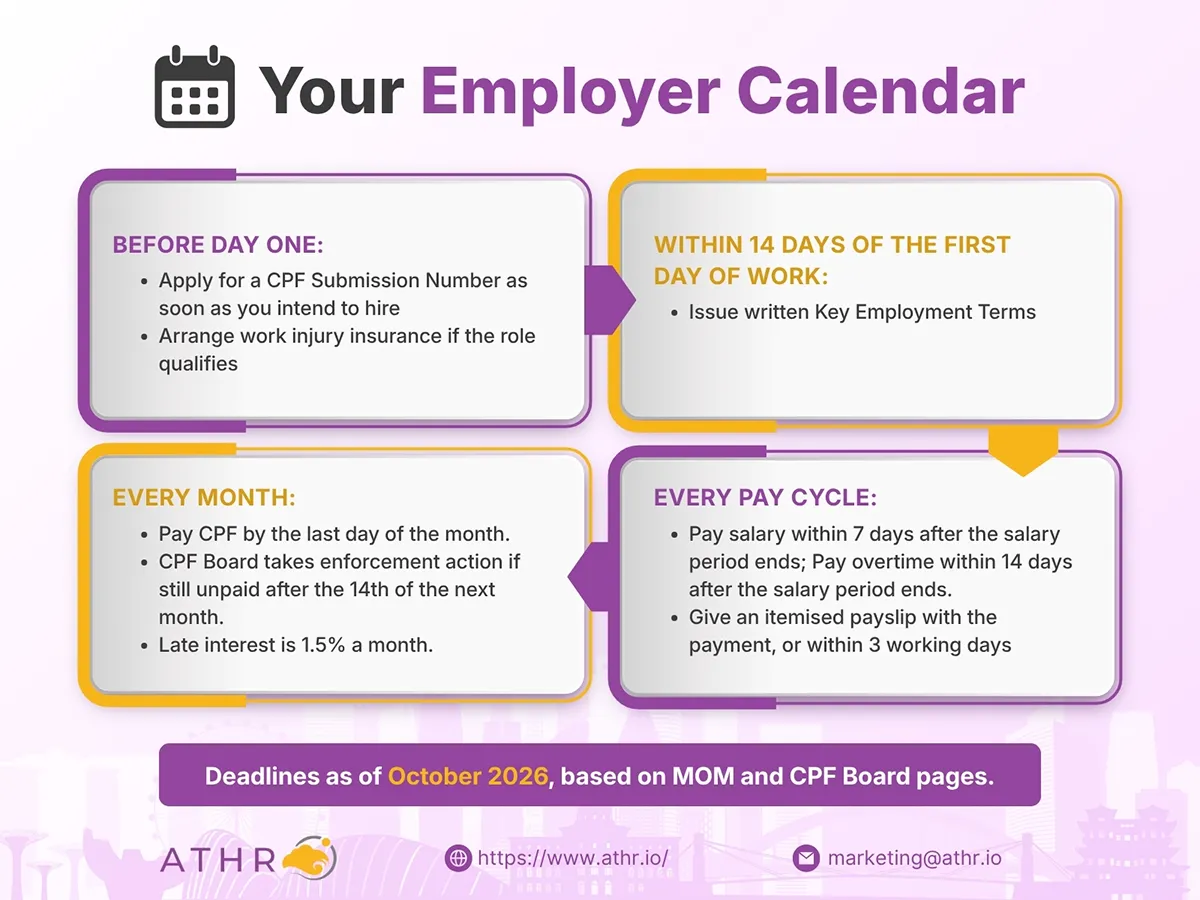
Your duties arrive in a predictable order:
Before day one: a CPF Submission Number, work injury insurance if the role qualifies, a fair hiring process and the terms you will offer.
In the first 14 days: written Key Employment Terms.
Every pay cycle: salary and overtime on time, an itemised payslip and a record of attendance and hours.
Every month: CPF contributions for citizens and PRs.
During employment: paid leave, public holidays, flexible work requests and fair treatment.
At exit: notice, final pay and a payslip issued with it.
Should You Hire an Employee, Use a Contractor or Outsource?
Hire an employee when you control how, when and where the work is done and expect it to continue. Use a contractor when someone runs their own business and delivers a result, and outsource when a provider can carry a function such as payroll.
MOM looks at the substance of the working relationship, not the label on the agreement, so calling someone a contractor does not remove employer duties. Control over working hours, how closely you direct the work and whether the person can work for other clients all point one way or the other. MOM's guide on employment laws explains the difference between a contract of service and a contract for service.
Outsourcing moves the administration, not the legal responsibility. A payroll provider can calculate and file, but you remain the employer. ATHR's guides to outsourcing payroll versus doing it in-house and payroll cost for local and foreign staff help you weigh that choice.
Employer Calendar
Which Employer Requirements Must You Set Up Before the First Day?
Before day one you need a CPF Submission Number (CSN) if you will employ a citizen or PR, work injury insurance if the role qualifies, and a fair hiring process. CPF Board advises applying for the CSN as soon as you intend to hire your first employee.
Step 1: Apply for a CPF Submission Number. The CSN is the number CPF Board gives an employer for submitting contributions. You apply through Singpass with your company's UEN, the unique entity number ACRA gives your business, following CPF Board's guide for new employers. ACRA's post-registration guide also lists the CSN as a step before you pay CPF.
Step 2: Arrange work injury insurance.MOM requires cover for all manual workers, whatever their salary, and for non-manual workers earning S$2,600 or less a month. Overtime, bonuses, the annual wage supplement and allowances do not count towards that figure. The payout must not fall below the compensation limits in the Work Injury Compensation Act, so ask your insurer to confirm the policy meets them. ATHR's guide to employee insurance and benefits covers the wider options.
Step 3: Decide the terms you will offer. Settle the role, pay, hours, leave and notice period. The salary period and pay date appear in the written terms, so choose ones your payroll can meet.
Step 4: Confirm the person's right to work. A citizen or PR needs no pass. A foreign hire needs the right work pass before starting, covered below.
Practitioner's Note:
The CSN is easy to forget because nothing in the hiring process asks for it. The first salary date then arrives with no number to file under. Put the CSN on the hiring checklist next to the contract, and apply when you decide to hire, not when you run the first payroll.
Details Included in Singapore Employment Contracts
What Must Your Employment Contract Include?
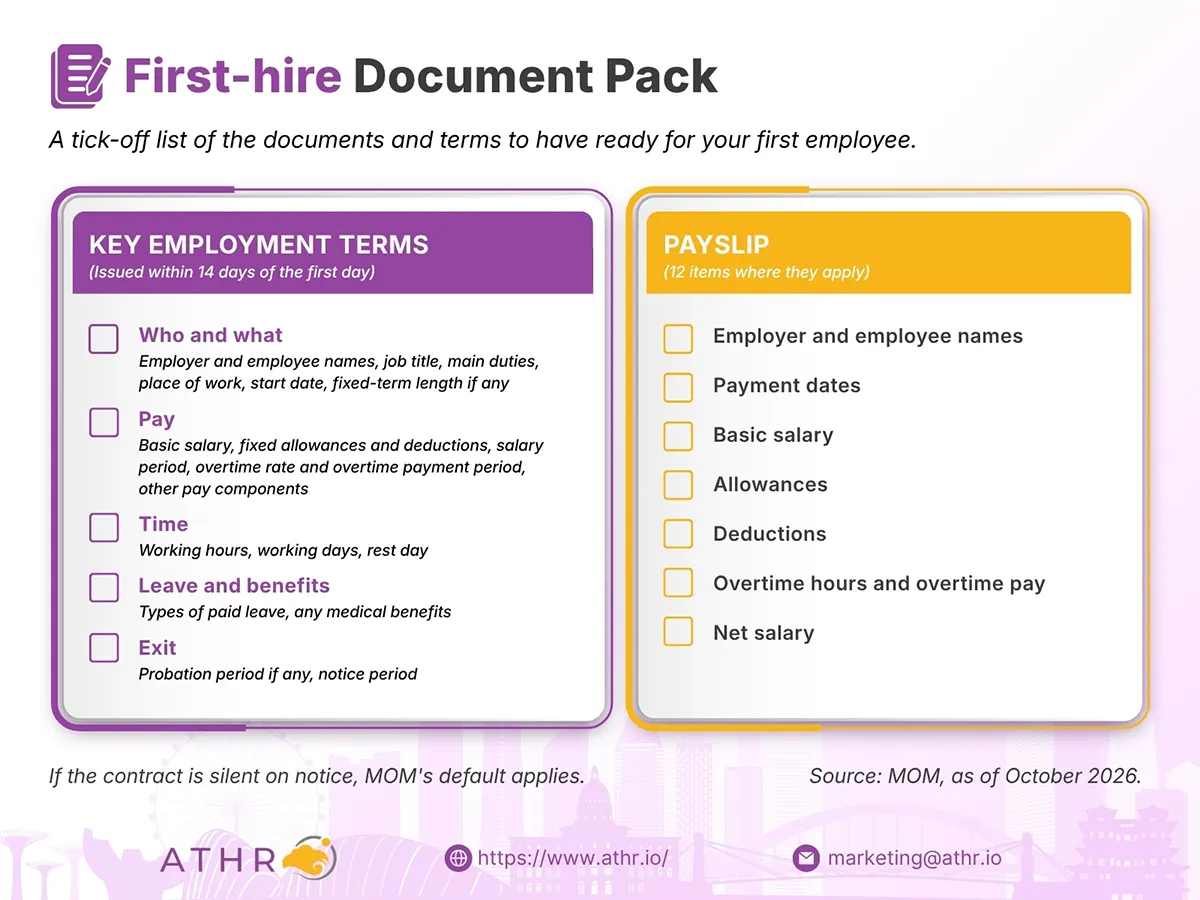
You must give covered employees written Key Employment Terms (KETs) within 14 days of their first day of work. MOM's employer toolkit applies the rule to employees under the Employment Act who are hired for 14 days or more.
KETs are the core terms of the job in writing. MOM's guide lists 18 items, and the WorkRight page links a KETs template. In practice the items fall into five groups:
Who and what: the employer and employee names, job title, main duties, place of work, start date and, for a fixed-term contract, how long it lasts.
Pay: basic salary, fixed allowances and deductions, the salary period, the overtime rate and overtime payment period, and other pay components.
Time: working hours, working days and the rest day.
Leave and benefits: the types of paid leave and any medical benefits.
Exit: the probation period, if any, and the notice period.
Either way, the 14 days run from the first day of work, so a start date that moves by a week moves the deadline too.
Set a notice period in the contract. If the contract is silent, MOM's default notice depends on length of service. It is 1 day under 26 weeks and 1 week from 26 weeks to under 2 years. It is 2 weeks from 2 years to under 5 years, and 4 weeks from 5 years. The period must be the same for employer and employee, and notice must be in writing.
Salary in lieu of notice is money equal to the pay earned over the notice period, paid in place of working it, and no CPF is due on it. MOM adds that neither side has to give a reason when terminating with notice, and that both can waive the notice by mutual consent, ideally in writing.
Practitioner's Note:
Probation and notice are easy to leave vague. A probation clause with no length, or notice that differs between employer and employee, leaves you relying on MOM's default. Write both plainly, and keep notice identical for both sides.
How Must You Pay Your Employee?
Pay your employee at least once a month and within 7 days after the salary period ends, and pay overtime within 14 days. Give an itemised payslip with the payment or within 3 working days of it.
The table sets out the main pay deadlines.
Duty
Deadline
Salary
Within 7 days after the salary period ends, and at least once a month
Overtime pay
Within 14 days after the salary period ends
Itemised payslip
With the payment, or within 3 working days of it; with the outstanding salary on exit
CPF contributions
By the last day of the month, with enforcement action if still unpaid after the 14th of the next month
Late CPF interest
1.5% a month
Payslip records
Latest 2 years for current staff; for former staff, the last 2 years, kept for 1 year after they leave
Each deadline comes from a different agency, so calendar all of them together.
MOM's payslip page lists 12 items a payslip must show where they apply. They include the employer and employee names, payment dates, basic salary, allowances, deductions, overtime hours and pay, and net salary. Electronic payslips are allowed. The salary deadline comes from MOM's paying salary page, and the CPF dates and interest from CPF Board.
The 7-day deadline runs from the end of the salary period, not from the day you approve payroll. For a period ending on the 31st, the deadline is the 7th, so approving on the 6th leaves one day for the bank transfer. Fix the approval date in your calendar before the period ends.
What Working Hours, Rest Days and Leave Must You Give?
Part 4 of the Employment Act sets hours, overtime and rest days for workmen earning up to S$4,500 basic a month and non-workmen earning up to S$2,600. Leave and public holidays apply more widely, to employees the Act covers.
Working Hours and Overtime
MOM sets normal hours at up to 9 hours a day if the working week is 5 days or fewer. The limit is 8 hours a day if the week is longer, with a ceiling of 44 hours a week either way. Overtime is any work beyond normal hours, paid at no less than 1.5 times the hourly basic rate.
An employee cannot work more than 12 hours a day, and overtime is capped at 72 hours a month unless MOM grants an exemption. Keep a record of attendance and hours, because overtime pay depends on it.
Rest Days and Public Holidays
Give one rest day a week, a whole day from midnight to midnight, with no more than 12 days between rest days. Employees get 11 paid public holidays a year, and MOM's public holiday page sets the pay when someone works on one.
Annual and Sick Leave
An employee earns paid annual leave after 3 months of service. The entitlement is 7 days in the first year, rising by 1 day a year to 14 days from the eighth year. Part years are pro-rated by completed months.
Paid sick leave also starts at 3 months. At 3 months an employee has 5 paid outpatient days and 15 hospitalisation days, rising to 14 and 60 days from the sixth month. Below 3 months, sick leave is unpaid.
Parental Leave in Brief
From 1 April 2026, Shared Parental Leave rises from 6 to 10 weeks for children born on or after that date. MSF says parents can take up to 30 weeks of paid leave in a child's first year when the benefits are combined. Entitlements depend on the parent's status and the child's birth date, so check MSF's page for each case. ATHR's note on childcare leave and payroll covers how the leave is tracked.
Say an employee on a 5-day week joins on 1 March. By 1 June they have 3 months of service, so paid sick leave begins with 5 outpatient days. Annual leave is 2 days, which is 7 days pro-rated for 3 completed months and rounded up.
What Other Duties Come With Hiring?
Beyond pay and leave, employers must handle flexible work requests properly, prepare for the Workplace Fairness Act and keep the workplace safe.
Flexible work arrangements. The Tripartite Guidelines on Flexible Work Arrangement Requests took effect on 1 December 2024. TAFEP says employers should have a process for requests, give a written decision within 2 months, and give reasons if they decline. A refusal should rest on reasonable business grounds.
Workplace fairness. Parliament passed the Workplace Fairness Act on 8 January 2025, and TAFEP's workplace fairness page says it is slated to take effect by the end of 2027. A related dispute resolution bill passed on 4 November 2025. Hiring and grievance practices written down now will not need rebuilding later.
Workplace safety. Employers owe a duty to keep the workplace safe from the first hire. MOM's heat stress requirements are a recent example, covered in ATHR's note on MOM heat stress rules.
What Changes When You Hire a Foreign Employee?
A foreign employee needs a valid work pass, is covered by the Employment Act like any other employee, and does not attract CPF contributions. The Employment Pass is the usual route for professionals.
MOM's Employment Pass page sets a qualifying salary of at least S$5,600 a month for new applications, or S$6,200 in financial services, together with the COMPASS points test. For new applications from 1 January 2027, those salaries rise to S$6,000 and S$6,600.
MOM's Fair Consideration Framework requires Employment Pass and S Pass jobs to be advertised on MyCareersFuture for at least 14 consecutive days, with some exemptions. Advertise first, then apply.
Treating an employee as a contractor to avoid employer duties. MOM looks at the working relationship, not the title. A person who works set hours under your direction points to an employee. Test each arrangement before the first payment.
Missing the CPF Submission Number. Without a CSN you cannot pay CPF for a citizen or PR, and late payments attract interest of 1.5% a month. Apply when you decide to hire.
Issuing written terms late. The 14 days run from the first day of work. Diarise the date when the offer is signed, and issue the Key Employment Terms with the contract.
Skipping work injury insurance for a role that qualifies. Founders often assume the rule covers only manual roles. Non-manual staff earning S$2,600 or less a month need cover too, and the penalty can reach S$10,000, 12 months in jail, or both.
Applying CPF to every hire, or to none. CPF applies to citizens and PRs and not to foreign pass holders. Mixing them up produces wrong deductions and wrong filings.
Frequently Asked Questions About Employer Requirements in Singapore
Do I need to register as an employer before my first hire?
You need a CPF Submission Number if you will pay CPF for a citizen or PR, and CPF Board advises applying as soon as you intend to hire. If you hire only foreign pass holders, no CPF is due. The other duties in this guide still apply.
Do I have to give my employee a written contract?
The legal requirement is written Key Employment Terms, issued within 14 days of the first day of work to covered employees hired for 14 days or more. Many employers fold the KETs into the employment contract so the employee has one document.
Do I pay CPF for a foreign employee?
No for foreign pass holders. CPF Board says employers pay CPF for Singapore citizens and PRs whose wages are above S$50 a month. The Employment Act, payslip and leave rules still apply to the foreign employee.
How much annual leave must I give?
Employees with 3 months of service get paid annual leave. The entitlement is 7 days in the first year, rising by 1 day a year to 14 days from the eighth year. Leave in part years is pro-rated by completed months, per MOM.
Is a freelancer an employee?
It depends on the arrangement, not the label. MOM distinguishes a contract of service, which creates an employee, from a contract for service, which does not. Control over hours and methods, and whether the person serves other clients, are the usual signals.
What happens if I pay CPF late?
CPF Board charges interest of 1.5% a month on late contributions. It also takes enforcement action if payment is still missing after the 14th of the following month, so pay by the due date.
Do I need work injury insurance for my first hire?
If the role is manual, yes, whatever the salary. If it is non-manual, yes when the employee earns S$2,600 or less a month, excluding overtime, bonuses and allowances. The penalty for not insuring is a fine of up to S$10,000, jail of up to 12 months, or both.
How ATHR Can Help
Start by telling us who you plan to hire, their nationality and pass status, the role and salary, and the planned start date. That tells us whether CPF applies, whether the role needs work injury insurance and which pass the hire needs.
ATHR's payroll management service covers payroll calculations and CPF submissions, and the team also supports work pass applications. A dedicated key account manager and the ATHR platform track each deadline, so a missing step is caught before the date it is due.
The ATHR Content Team is a group of professional writers from Singapore and the Philippines, committed to delivering informative, practical, and engaging content for business owners across Southeast Asia.
Free yourself from routine business tasks and let ATHR take the weight of financial administration off your shoulders. Smart solutions, seamless service, zero hassle.