Every Singapore company files a corporate income tax return each year, and for most small companies that return is Form C-S. For Year of Assessment 2026, the deadline is 30 November 2026. It applies even if your company made a loss or had very little activity.
Form C-S is designed to be simple, and for many companies it takes less than an hour to complete once the figures are ready. The time goes into getting those figures ready. This guide walks you through which form to use, the key dates, what to prepare, each step on myTax Portal, and the mistakes we see most often.
Key Takeaways
Form C-S is for companies incorporated in Singapore with revenue of S$5 million or less, all income taxed at 17%, and no special claims.
Companies with revenue of S$200,000 or less can use the shorter Form C-S (Lite).
YA2026 covers the financial year ending in 2025. The filing deadline is 30 November 2026.
You do not submit financial statements or the tax computation with Form C-S, but you must prepare them and keep them.
The YA2026 CIT rebate of 50%, capped at S$40,000, is calculated automatically when IRAS assesses your return.
What Is Form C-S and Who Can Use It?
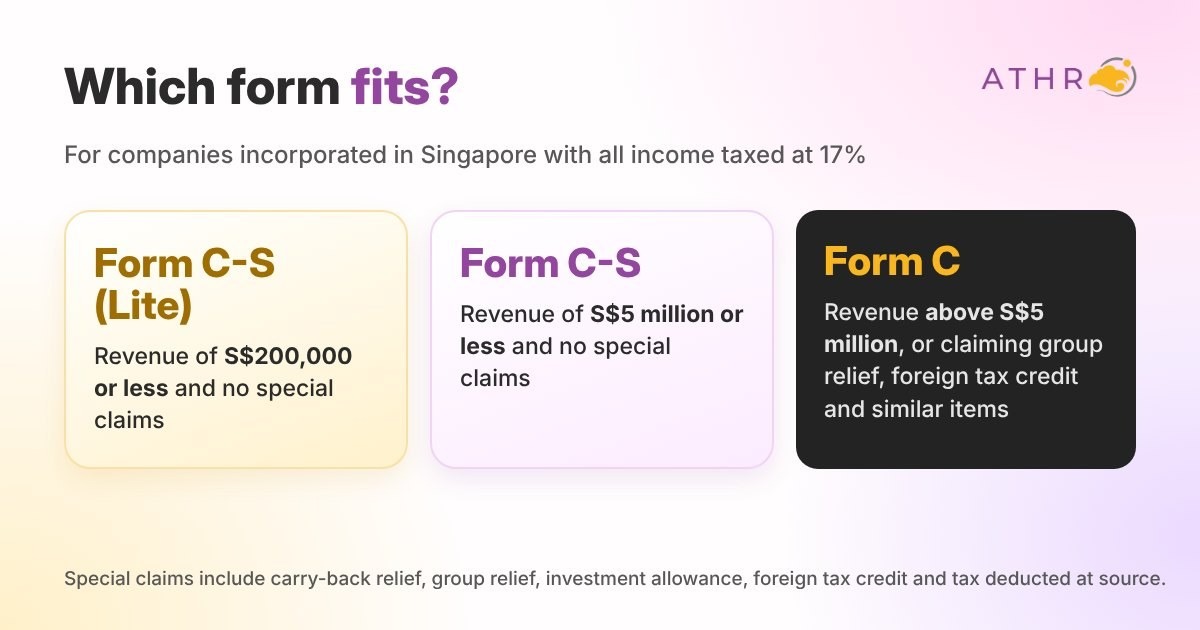
Form C-S vs C-S (Lite) vs Form C
IRAS offers three versions of the corporate income tax return:
Form C-S (Lite) is the shortest. It is for the smallest companies.
Form C-S is a simplified return for most small and medium companies.
Form C is the full return, where you also submit financial statements and the tax computation.
Which form fits: Form C-S (Lite), Form C-S and Form C compared
The Qualifying Conditions
Your company can file Form C-S if it meets all of these conditions:
It is incorporated in Singapore.
Its annual revenue is S$5 million or less.
All its income is taxable at the prevailing corporate tax rate of 17%.
It is not claiming any of the following in that Year of Assessment: carry-back of current year capital allowances or losses, group relief, investment allowance, foreign tax credit, or tax deducted at source.
If any of the conditions above are not met, the company files Form C. Typical examples are companies with revenue above S$5 million, companies incorporated overseas with a Singapore branch, companies with income taxed at a concessionary rate, and companies claiming group relief or foreign tax credits.
Key Dates for YA2026
Basis Period: FY2025
Singapore taxes income on a preceding year basis. For YA2026, the basis period is the financial year that ended in 2025. If your company's year end is 31 December, you are reporting income for 1 January to 31 December 2025. If your year end is 30 June, you are reporting the year that ended on 30 June 2025. Our article on choosing a financial year end explains how this works if you are unsure.
Deadline: 30 November 2026
All YA2026 corporate income tax returns are due by 30 November 2026, whichever form you use. IRAS publishes the year's filing guidance on its Corporate Income Tax Filing Season 2026 page.
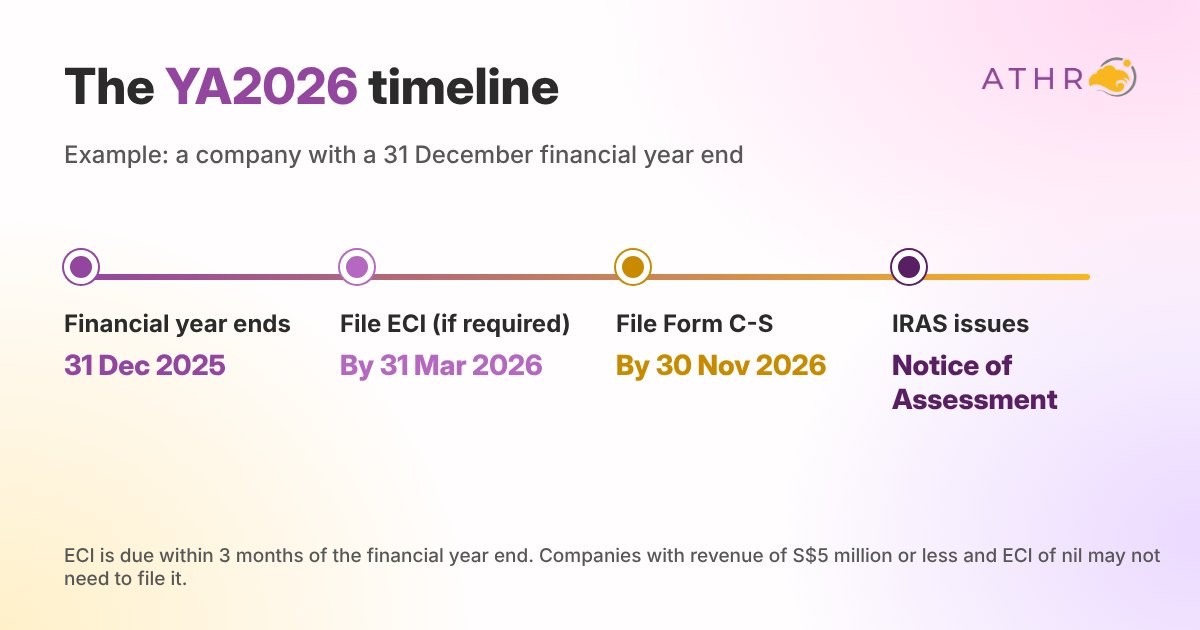
Before Form C-S, many companies also need to file Estimated Chargeable Income (ECI) within three months of their financial year end. Companies with revenue of S$5 million or less and ECI of nil may not need to file it. Our guide to ECI filing covers this in detail.
The YA2026 timeline for a company with a 31 December year end
Late Filing Consequences
If you miss the deadline, IRAS may:
Issue an estimated Notice of Assessment based on its own estimate of your income, with tax payable within one month
Impose a composition fine
Summon the company's directors to court for failing to file
An estimated assessment can only be revised by filing the actual return. It is far simpler to file on time.
Dormant Companies and Waivers
A dormant company is still required to file unless IRAS has granted a waiver. If your company has stopped trading and has no income, you may apply for a waiver of the requirement to file. Until a waiver is granted, keep filing.
What to Prepare Before You File
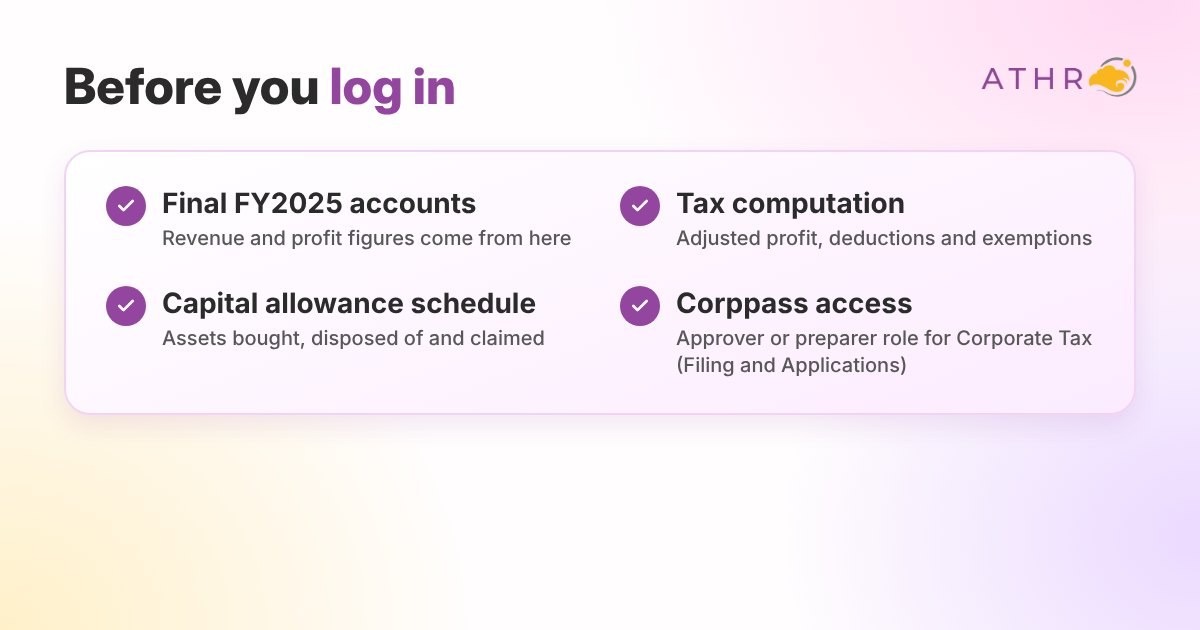
This is the part that takes the time. Have these ready before you log in.
Checklist of what to prepare before filing Form C-S
Final Financial Statements
You need your final accounts for the financial year, including the profit and loss statement and balance sheet. The revenue you declare on Form C-S should match the revenue in these accounts exactly. If you are still finalising your accounts, see our year-end checklist for what usually needs to be closed off.
Tax Computation
The tax computation starts from your accounting profit and adjusts it to arrive at chargeable income. It adds back expenses that are not deductible, such as private expenses, depreciation, fines and certain donations, and deducts income that is not taxable or is taxed separately. Form C-S asks for figures that come straight from this computation.
You do not submit the tax computation with Form C-S. You must still prepare it and keep it, because IRAS can ask for it at any time.
Fixed Asset and Capital Allowance Schedules
If your company bought or sold equipment, computers, vehicles or other fixed assets, you will need a schedule showing capital allowances. Capital allowances replace accounting depreciation for tax purposes.
Corppass Roles for myTax Portal
The person filing needs the right access. In Corppass, they should be assigned the "Corporate Tax (Filing and Applications)" e-Service, as either a preparer or an approver. A preparer can fill in the form, but only an approver can submit it. If your tax agent is filing, the company authorises them through Corppass as well. Sort this out early, because Corppass changes often stall in the final week.
Step-by-Step: Filing Form C-S on myTax Portal
IRAS updates the screens from time to time, so the labels you see may differ slightly. The flow below is what most small companies will go through.
Step 1: Log In and Select the Year of Assessment
Log in to myTax Portal with Singpass through Corppass. Go to Corporate Tax, then File Form C-S/ C-S (Lite)/ C. Select YA2026. The system will ask a few questions to confirm which form you are eligible for.
Step 2: Company Particulars
Check the company details shown, including the financial year end and principal activities. Answer the questions about the company's status, such as whether it is claiming any of the items that would make it ineligible for Form C-S. If any answer moves you out of Form C-S, the system will guide you to Form C instead.
Step 3: Income and Adjustments
This is the core of the form. You enter figures from your financial statements and tax computation, including revenue, adjusted profit or loss before other deductions, and items such as non-deductible expenses and non-taxable income. Take your time here and enter figures exactly as they appear in your workings.
Step 4: Capital Allowances and Losses
Enter capital allowances for the year and any balances brought forward from earlier years. If the company has unutilised losses or capital allowances from previous years, these can generally be carried forward and set off against this year's income, subject to the shareholding test.
Step 5: Declaration and Submission
Review the summary page. Check the revenue figure, the chargeable income and the tax position against your tax computation. The approver then makes the declaration and submits the form.
Step 6: Save the Acknowledgement
After submission, you will see an acknowledgement page. Save or print it and keep it with the company's tax records. IRAS will issue the Notice of Assessment later, usually within a few months.
Form C-S (Lite): The Shorter Version
If your company's revenue is S$200,000 or less and it meets the other Form C-S conditions, you can file Form C-S (Lite). IRAS describes it as a simplified return with only six essential fields to complete. In practice, that means you type in a handful of key figures from your accounts and tax computation, starting with revenue, which is compulsory. Some items, such as unutilised capital allowances and losses brought forward from earlier years, are pre-filled by IRAS for you to check. It still relies on the same work behind it: your accounts and tax computation need to be prepared in the same way, even though fewer figures are entered on the form itself.
For many very small companies, such as consultancies, holding companies and early-stage startups, this makes filing noticeably quicker. If you are not sure whether you qualify, myTax Portal will check eligibility based on your answers at the start of the filing.
YA2026 Rebate and Exemptions
You do not need to calculate these yourself on Form C-S. IRAS applies them when it assesses your return. It still helps to understand them so you know what to expect. Our article on the YA2026 CIT rebate goes into more detail.
CIT Rebate of 50%, Capped at S$40,000, and the Cash Grant
Budget 2026 announced a YA2026 corporate income tax rebate of 40%. On 7 April 2026, this was enhanced to 50% of tax payable, capped at S$40,000. Companies that employed at least one local employee in 2025 also receive a minimum benefit of S$2,000, paid as the CIT Rebate Cash Grant. The cash grant counts toward the overall S$40,000 cap, so the rebate given on assessment is reduced by any cash grant already paid.
Partial Tax Exemption and SUTE
Two exemption schemes reduce the chargeable income that is taxed:
Partial tax exemption applies to all companies: 75% of the first S$10,000 of chargeable income and 50% of the next S$190,000 are exempt.
Start-up tax exemption (SUTE) applies to qualifying new companies for their first three Years of Assessment: 75% of the first S$100,000 and 50% of the next S$100,000 are exempt.
A company can only use one of the two in any Year of Assessment. For a general overview of how these fit together, see our Singapore tax 2026 overview.
Common Mistakes to Avoid
Six common Form C-S mistakes
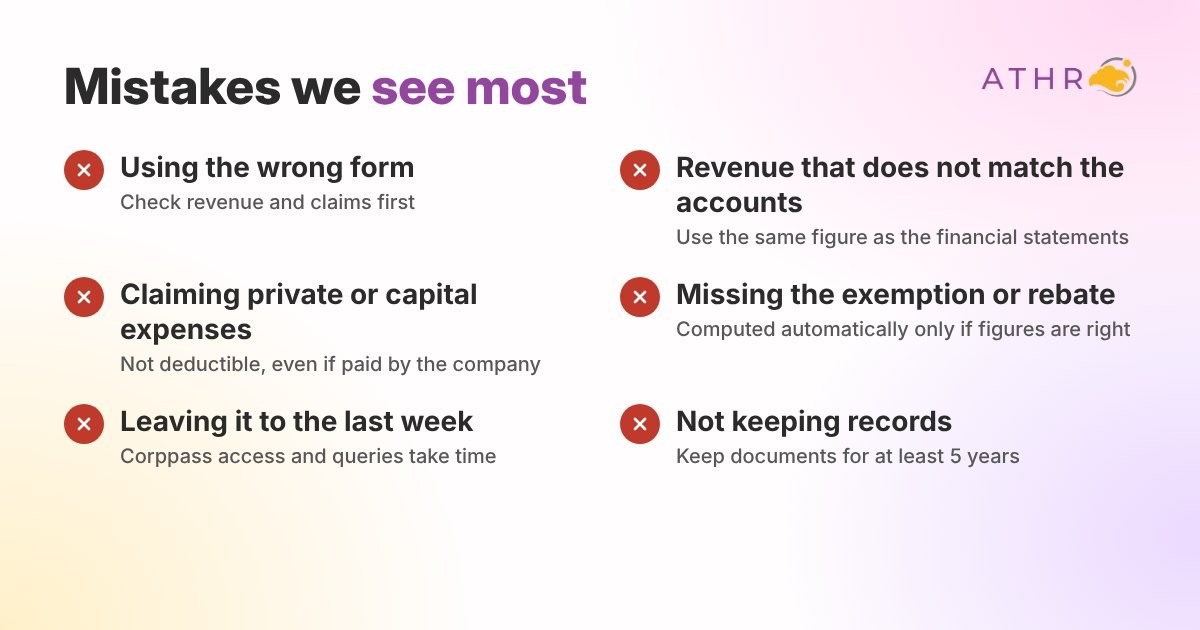
Using the wrong form: Check revenue and whether you are claiming any special items before you start.
Revenue that does not match the accounts: IRAS compares the figures, so use exactly the same number.
Claiming private or capital expenses: A director's personal car costs or the purchase price of equipment are not deductible as expenses, even if the company paid them.
Missing the exemption or rebate: These are applied automatically, but only if the figures you enter are right.
Leaving it to the last week: Corppass access, missing documents and questions for your accountant all take time.
Not keeping records: Companies must keep supporting records for at least five years.
What If You Find an Error After Filing?
If you discover a mistake after submitting Form C-S, you can request a revision. If the Notice of Assessment has not been issued, you can usually make a revision through myTax Portal. If it has been issued, write to IRAS with the correct figures and an explanation, generally within four years from the end of the Year of Assessment. Making a voluntary correction promptly is treated more leniently than an error IRAS finds itself, under IRAS's voluntary disclosure programme.
Frequently Asked Questions
Do I submit financial statements with Form C-S?
No. With Form C-S and Form C-S (Lite), you do not submit financial statements or the tax computation. You must prepare them and keep them, and IRAS may ask for them later. With Form C, they are submitted together with the return.
My company made a loss. Do I still file?
Yes. Every company must file a return for YA2026 by 30 November 2026, whether it made a profit, a loss or had no income. Filing also records the loss so it can be carried forward to future years.
Can I switch from Form C to C-S?
The form depends on the company's position for each Year of Assessment. If your company filed Form C last year but now meets all the Form C-S conditions, you can file Form C-S this year. The opposite also applies.
Who can file for the company?
A person authorised in Corppass for the Corporate Tax (Filing and Applications) e-Service, either from the company itself or from an appointed tax agent. Only an approver can submit the return.
How ATHR Can Help
Form C-S is simple when the figures behind it are right. ATHR's tax and accounting team can:
Prepare or review your financial statements
Prepare your tax computation and capital allowance schedules
File ECI and Form C-S, C-S (Lite) or Form C on your behalf
Handle IRAS queries and revisions after filing
With 30 November close, now is a good time to start. Talk to our tax team and we will help you file once, and file right.
Disclaimer
This article is for general information only and reflects IRAS guidance available at the time of writing. It is not tax or professional advice. myTax Portal screens and requirements may change. Please refer to IRAS or speak to a qualified tax professional before filing.
ATHR Content Team
ATHR Articles & Guides
The ATHR Content Team is a group of professional writers from Singapore and the Philippines, committed to delivering informative, practical, and engaging content for business owners across Southeast Asia.
Free yourself from routine business tasks and let ATHR take the weight of financial administration off your shoulders. Smart solutions, seamless service, zero hassle.