A new hire starts on 19 October. Another employee's last day is 13 November. A third takes three days of no-pay leave in December. Each of these employees has an incomplete month, and each needs a salary that is neither a full month's pay nor a rough estimate.
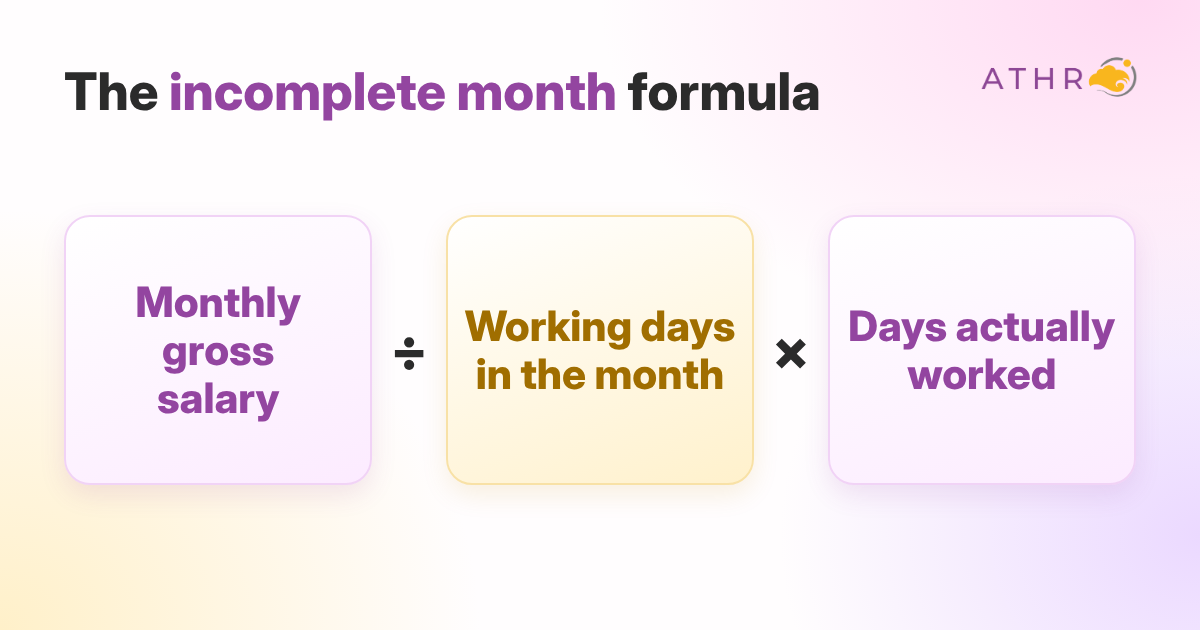
The Ministry of Manpower (MOM) sets out one formula for these situations: monthly gross salary ÷ working days in the month × days actually worked. The formula itself is simple. Most errors come from the two day counts, especially how public holidays and paid leave are treated.
This guide explains when a month counts as incomplete, how to apply the MOM formula, worked examples for joiners, leavers and no-pay leave, and what to check for CPF and final salary payments. Figures are current as of 27 October 2026.
Key Takeaways
An incomplete month generally applies when an employee joins after the first day, leaves before the last day, takes no-pay leave or goes for reservist training in that month.
The MOM formula is monthly gross salary ÷ total working days in the month × days actually worked.
Public holidays count in both numbers. They are included in the month's working days and in the days actually worked.
Paid leave counts as days worked, including annual leave and paid hospitalisation leave.
Final salary timing depends on how employment ends. An employee who resigns with notice should generally be paid on the last day of employment.
Foreign and PR employees who leave may need tax clearance (Form IR21), which affects when final payments can be released.
What Counts as an Incomplete Month?
An incomplete month is any month in which a monthly-rated employee does not work the full month. MOM's guidance on monthly and daily salary lists the situations that commonly cause it.
The employee joins after the first day of the month
A new hire who starts on 19 October has not worked the first part of the month, so October is an incomplete month for that employee.
The employee leaves before the last day of the month
An employee whose last day of employment is 13 November has an incomplete November, whether they resigned, their contract ended or the employer terminated the employment.
The employee takes no-pay leave
Approved no-pay leave reduces the days actually worked. A monthly-rated employee who takes even one day of no-pay leave has an incomplete month for that period.
The employee goes for reservist training
MOM also lists reservist training (in-camp training) as a cause of an incomplete month. Employers can generally claim make-up pay from the government for National Service reservist training, so check how your payroll records this.
Who this applies to
The formula is designed for monthly-rated, full-time employees. Part-time employees are usually paid by the hour or day under their own contract terms, so the incomplete month formula is not normally used for them. If you are unsure which terms apply, start with the employee's Key Employment Terms. Our guide to hiring in Singapore covers the documents every employer should have in place.
How Do You Calculate Incomplete Month Salary?
Divide the monthly gross salary by the total working days in that month, then multiply by the number of days the employee actually worked.
The MOM formula
(Monthly gross rate of pay) / (Total number of working days in that month) x Total number of days the employee actually worked in that month
Each of the three inputs needs to be defined carefully. The next two sections explain the day counts, and a later section covers what goes into the monthly gross rate of pay.
The incomplete month formula
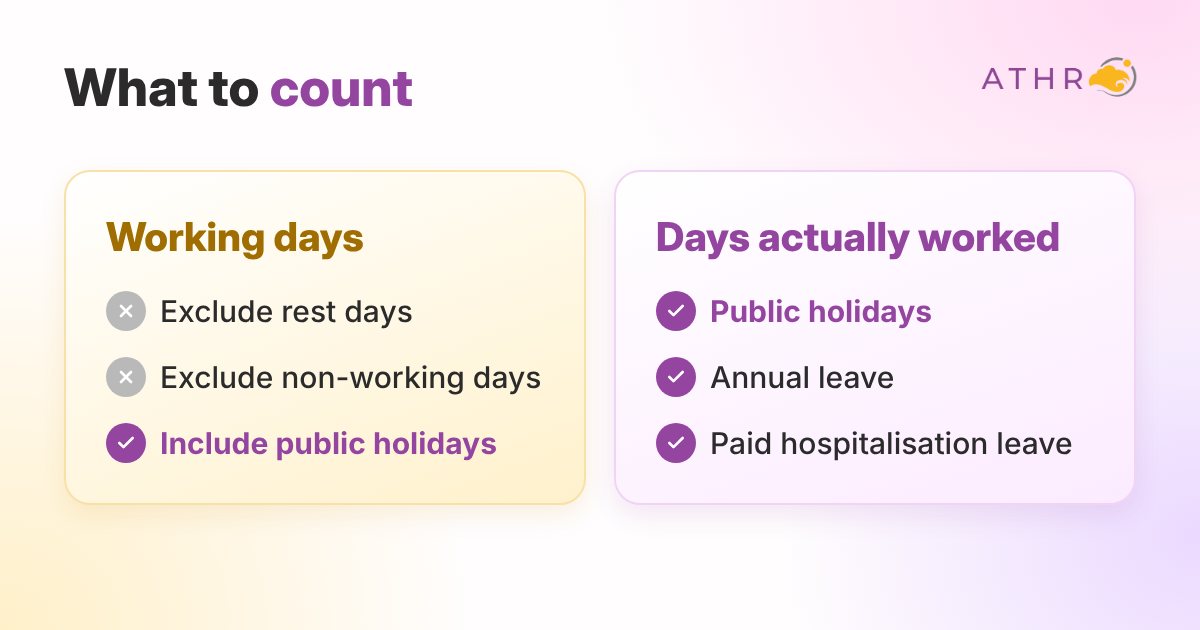
What counts as a working day
Total working days are the days in that month on which the employee is normally required to work. According to MOM:
Exclude rest days and non-working days. For a Monday to Friday schedule, this means Saturdays and Sundays.
Include public holidays that fall on a normal working day.
The number of working days therefore changes from month to month and depends on the employee's work pattern. MOM publishes a table of monthly working days for common schedules on the same monthly and daily salary page.
What counts as a day actually worked
Days actually worked are the working days in the month on which the employee was employed and not on no-pay leave. According to MOM, they include:
Days the employee physically worked.
Public holidays.
Paid annual leave.
Paid hospitalisation leave, where the employee is entitled to it.
What to count
No-pay leave days and days before the start date or after the last day of employment are not counted.
Practitioner's Note:
The most common mistake we see is removing public holidays from the calculation, either by leaving them out of the month's working days or by not counting them as days worked. Some payroll guides online also exclude public holidays. Under MOM's approach, they are included in both numbers, which affects the result in any month with a public holiday.
Worked Examples: Joiners, Leavers and No-Pay Leave
The examples below assume a Monday to Friday work week and use the 2026 public holiday calendar. Amounts are rounded to the nearest cent.
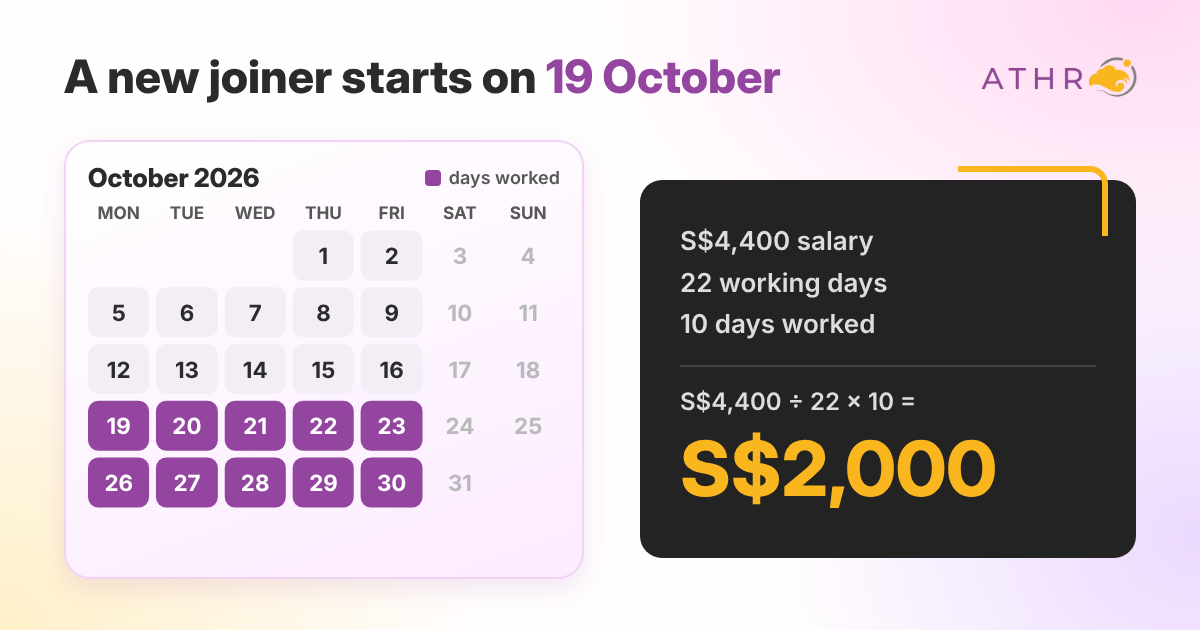
Example 1: A new joiner in October 2026
Mei Ling joins on Monday, 19 October 2026, with a monthly gross salary of S$4,400.
October 2026 has 22 working days (Monday to Friday) and no public holidays.
From 19 to 30 October, she works 10 days.
October salary: S$4,400 ÷ 22 × 10 = S$2,000.
October calendar example
Example 2: A leaver in a month with a public holiday
Arjun's last day of employment is Friday, 13 November 2026. His monthly gross salary is S$4,620.
Deepavali falls on Sunday, 8 November 2026, so Monday, 9 November is a public holiday in lieu.
November 2026 has 21 working days, and the public holiday on 9 November is included in that count.
From 2 to 13 November, Arjun has 10 days actually worked, which includes the public holiday on 9 November.
November salary: S$4,620 ÷ 21 × 10 = S$2,200.
If the public holiday were wrongly left out of both counts, the calculation would become S$4,620 ÷ 20 × 9 = S$2,079, underpaying Arjun by S$121.
Example 3: No-pay leave in December 2026
Farah earns S$5,060 a month and takes three days of approved no-pay leave in December 2026.
December 2026 has 23 working days, including Christmas Day on Friday, 25 December.
She has 23 − 3 = 20 days actually worked.
December salary: S$5,060 ÷ 23 × 20 = S$4,400.
Example 4: Employees on a 5.5-day or 6-day week
The same formula applies, but the number of working days changes. A 5.5-day week includes a half working day, usually on Saturday, and a 6-day week counts Saturdays as full working days. Use MOM's published table of monthly working days for these schedules, or set them up correctly in your payroll software, rather than reusing a Monday to Friday count.
Example
Monthly gross salary
Working days
Days actually worked
Salary for the month
Joiner, October 2026[cite: 21]
S$4,400[cite: 21]
22[cite: 21]
10[cite: 21]
S$2,000.00[cite: 21]
Leaver, November 2026[cite: 21]
S$4,620[cite: 21]
21[cite: 21]
10[cite: 21]
S$2,200.00[cite: 21]
No-pay leave, December 2026[cite: 21]
S$5,060[cite: 21]
23[cite: 21]
20[cite: 21]
S$4,400.00[cite: 21]
Incomplete Month Formula or Daily Rate: Which One Applies?
Use the incomplete month formula to pay salary for a partial month, and the daily rate of pay for specific payments and deductions. MOM defines the daily gross rate of pay for a monthly-rated employee as:
12 x (Monthly basic rate of pay) / 52 x (average number of days an employee is required to work in a week)
For an employee earning S$4,400 on a 5-day week, this is (12 × S$4,400) ÷ (52 × 5) = S$203.08 per day.
Situation
Method generally used
Joining or leaving part way through a month[cite: 22]
Incomplete month formula[cite: 22]
Approved no-pay leave[cite: 22]
Incomplete month formula[cite: 22]
Salary in lieu of notice[cite: 22]
Gross rate of pay per day[cite: 22]
Pay for unused annual leave[cite: 22]
Gross rate of pay per day[cite: 22]
Deduction for unauthorised absence[cite: 22]
Gross rate of pay per day[cite: 22]
Work on a rest day or public holiday[cite: 22]
Basic rate of pay per day[cite: 22]
Mixing the two methods is a common source of small but repeated payroll differences. Agree on one method per situation and record it in your payroll policy.
What Goes Into “Monthly Gross Salary”?
Monthly gross rate of pay includes the basic salary and allowances payable under the contract, but excludes variable and reimbursed amounts. According to MOM, it generally excludes:
Overtime pay.
Bonuses and the Annual Wage Supplement (AWS).
Reimbursements for special expenses.
Productivity incentive payments.
Travel, food and housing allowances.
If a fixed allowance forms part of the contractual monthly pay, include it before prorating. For a full breakdown of what employers pay on top of salary, see our article on employment benefits in Singapore.
How Does CPF Work for an Incomplete Month?
CPF contributions are generally calculated on the wages actually payable for the month, so a prorated salary leads to prorated CPF. For Singapore Citizens and Permanent Residents, a few points need attention:
Use the prorated amount as the Ordinary Wages for that month. In Example 1, CPF for October is based on S$2,000, not S$4,400.
The Ordinary Wage ceiling applies to the month's ordinary wages. In 2026, the ceiling is S$8,000 a month. Most prorated salaries fall well below it.
Check the employee's age and residency status. New Permanent Residents may be on graduated contribution rates in their first two years, which your payroll system must reflect from the first month.
Submit and pay on time. CPF contributions for a month are generally due by the 14th of the following month.
When bonuses or leave encashment are paid to a leaver, these are usually Additional Wages and subject to the annual Additional Wage ceiling. Our guide to payroll processing in Singapore covers the monthly CPF workflow in more detail, and our payroll accounting guide explains how to reconcile CPF payments with your records.
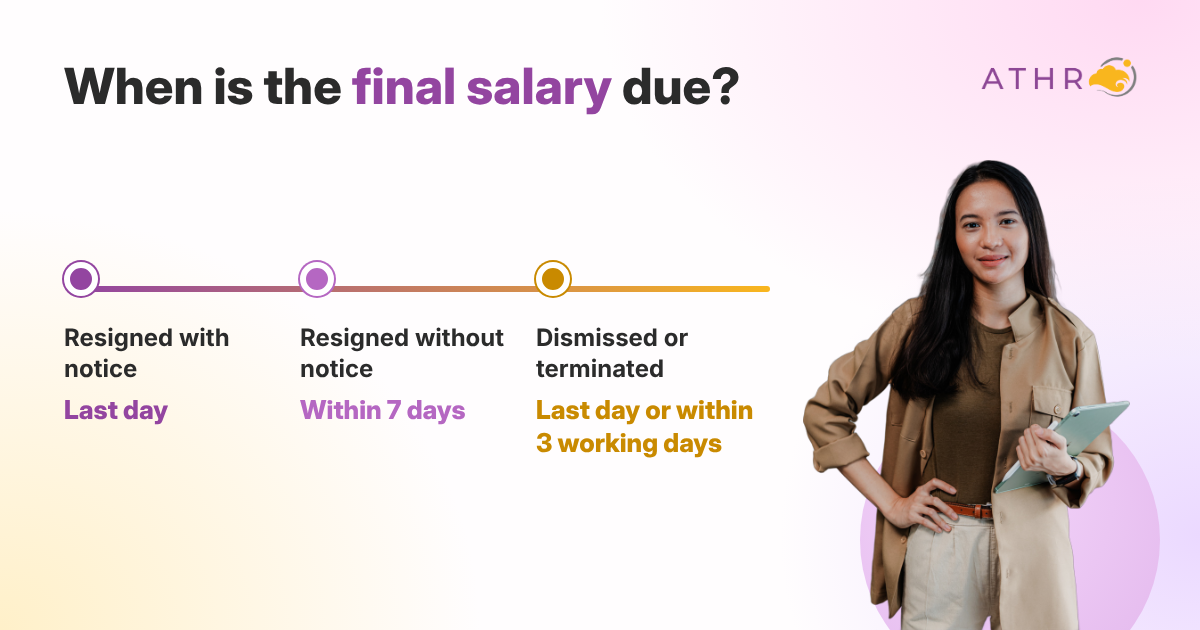
When Must Final Salary Be Paid?
The deadline depends on how the employment ends. MOM's rules on paying salary set the following timelines for employees covered by the Employment Act:
How employment ends
When the final salary is due
Employee resigns and serves the required notice[cite: 23]
On the last day of employment[cite: 23]
Employee resigns without serving the required notice[cite: 23]
Within 7 days after the last day of employment[cite: 23]
Employee is dismissed for misconduct[cite: 23]
On the last day of employment, or within 3 working days if that is not possible[cite: 23]
Employer terminates the contract[cite: 23]
On the last day of employment, or within 3 working days if that is not possible[cite: 23]
For ongoing employees, salary must be paid at least once a month and within 7 days after the end of the salary period. Overtime pay is due within 14 days after the end of the salary period.
The final payment usually combines several items: the prorated salary for the last month, pay for any unused annual leave, salary in lieu of notice where applicable, and any deductions allowed under the contract. Prepare an itemised payslip that shows each component clearly.
Final salary timeline
Foreign employees and Permanent Residents: tax clearance (Form IR21)
If a non-Singapore Citizen employee is leaving your company, you may need to file Form IR21 with IRAS before releasing the final payment. Based on IRAS guidance on tax clearance for employees:
File Form IR21 at least one month before the employee's last day of employment.
From the time you know the employee is leaving, withhold all monies due to them, including the final salary and leave pay.
Release the withheld amount only after IRAS issues its clearance directive. MOM notes that employers may withhold monies for up to 30 days once IRAS has been notified.
Some cases are exempt. Check the IRAS tax clearance guidance before filing.
This interacts with the MOM final salary deadlines above, so plan the IR21 filing as soon as the employee's notice is received.
Frequently Asked Questions
Should I use calendar days or working days to prorate salary?
MOM's formula uses working days, not calendar days. Dividing by 30 or 31 calendar days gives a different result and does not follow MOM's guidance for monthly-rated employees.
Do public holidays count when an employee joins or leaves mid-month?
Yes. A public holiday that falls on a normal working day is included in the month's working days. If it falls within the employee's period of employment, it also counts as a day actually worked.
Is no-pay leave treated the same as unauthorised absence?
Not quite. Approved no-pay leave is usually handled through the incomplete month formula. A deduction for unauthorised absence is generally calculated using the gross rate of pay per day. Record the two separately.
Does the incomplete month formula apply to part-time employees?
Generally not. Part-time employees are usually paid on an hourly or daily basis under their own contract terms. The incomplete month formula is designed for monthly-rated, full-time employees.
How is CPF calculated for a new joiner's first month?
CPF is generally calculated on the wages payable for that month. For a new joiner, this is the prorated salary. Apply the contribution rates for the employee's age and residency status.
Can I hold back a leaving employee's final salary?
Only in specific cases. For foreign and Permanent Resident employees who need tax clearance, employers must withhold monies due until IRAS issues its clearance directive. Otherwise, the final salary must be paid within MOM's deadlines.
How ATHR Can Help
Incomplete months come up every time someone joins, leaves or takes unpaid leave, and small differences repeat quickly if the method is not consistent. ATHR's payroll team supports Singapore businesses with:
Monthly payroll processing, including prorated salaries for joiners, leavers and no-pay leave.
CPF submissions and Self-Help Group contributions, calculated on the correct wages each month.
Final pay calculations, including leave encashment and salary in lieu of notice.
Form IR21 tax clearance and annual employment income reporting under the Auto-Inclusion Scheme.
Every client works with a dedicated Key Account Manager who knows your team and your payroll calendar.
This guide is for general information only and reflects MOM, CPF and IRAS guidance available as of 27 October 2026. It does not constitute legal, payroll or tax advice. Employment terms, contribution rates and deadlines may change, and the correct treatment depends on each employee's contract and circumstances. Please refer to the latest official publications or consult a qualified professional before acting on any information in this article. ATHR accepts no liability for any loss arising from reliance on this content.
ATHR Content Team
ATHR Articles & Guides
The ATHR Content Team is a group of professional writers from Singapore and the Philippines, committed to delivering informative, practical, and engaging content for business owners across Southeast Asia.
Free yourself from routine business tasks and let ATHR take the weight of financial administration off your shoulders. Smart solutions, seamless service, zero hassle.